Showing posts with label Stolen art. Show all posts

Friday, 29 May 2015

US returns looted art to Italy

This week saw the return by the United States of 26 pieces of art to Italy. Each work had been separately looted and subsequently smuggled out of Italy and into the US.

A Repatriation Ceremony was held at the US Embassy in Rome to celebrate the return of the pieces to Italy. The ceremony was a culmination of a lengthy investigation carried out collaboratively between the US Homeland Security Investigations (HSI) and the Carabinieri Tutela Patrimonio Culturale (TPC).

In his speech at the Ceremony, US Ambassador to Italy, John R. Phillips, noted that:
"Italy is blessed with a rich cultural legacy and therefore cursed to suffer the pillaging of important cultural artifacts. The collaboration between agents from HSI and investigators from the TPC has borne fruit in returning some important artifacts to their rightful home in Italy. 
The plundering of historical and cultural artifacts is among the oldest forms of cross-border organized crime. INTERPOL estimates that the illicit trading in cultural property produces more than $9 billion in profits each year – only human trafficking, narcotics and weapons trades generate more illicit revenue. 
The crime may be ancient, but the perpetrators are very modern. The use of the Internet has provided these criminals the ability to acquire, transport, advertise and sell valuable cultural property swiftly, easily and stealthily and while making it easier to evade detection by law enforcement agencies. 
Fortunately, the customs laws of the United States allows agencies such as HSI and CBP the ability to seize, forfeit and ultimately return cultural property that is brought into the United States illegally." 
Some of the artworks that were returned include:

Sleeping Beauty, a 1,800 year-old, ancient Roman marble sarcophagus lid of sleeping Ariadne, which investigation revealed was smuggled out of Italy. HSI New York special agents seized the sarcophagus lid with a warrant issued from the Eastern District of New York.

A 5th century B.C. Etruscan black figured Kalpis, which is believed to have been looted in Italy and smuggled into the United States in 1981. After an investigation, our HSI office in Cleveland, Ohio, seized the Kalpis.


A 5th century B.C. red-figured Attic Volute Krater attributed to the Methyse Painter. This Kalpis was seized by HSI St. Paul, Minnesota.


A 17th century Venetian bronze breech-loading gun, which was seized by CBP officers in Boston as it was being smuggled into the United States. After an HSI Boston investigation, the cannon was successfully forfeited.


Reportedly, no criminal charges have been filed in relation to any of returned artworks since, in some cases, the statute of limitations on any crimes would have expired, and, in others, the paper trail for the piece's import into the US was too difficult to reconstruct. In addition, these pieces represent but a fraction of the art currently circulating on the black market. Nonetheless, as Phillips stated "every victory, every piece that is returned, every bit of cultural history that can be restored to its rightful home is a measure of progress."

Source: The New York Times, 26 May 2015

Tuesday, 24 June 2014

Israel and Germany agree to cooperate on looted art

This blog has often covered cases and disputes over art stolen from Jews during World War II.

The most recent news on this topic appears to be rather positive. Last week Israel and Germany signed an agreement under which joint-research will be conducted in museums in both countries to determine the provenance of art suspected to be Jewish-owned art looted during World War II.

The AFP reports that under the agreement, which was signed by the countries' respective Culture Ministers, art experts from Israel and Germany will undergo training and coordinate the formation of joint databases.

The agreement apparently formalises the ongoing cooperation between the two countries, which was particularly tested recently with the discovery of the "Gurlitt stash" (reported here, here and here).

German Culture Minister Monika Gruetters released a statement about the agreement, which says that the agreement represents a "huge vote of confidence" as Germany does not work with any other country in this way. The statement also provides further details as to how the agreement and cooperation between the countries is intended to work in practice. [Unfortunately it is in German, and that's about as far as my German goes. Curious German speakers can read the rest here.]

It will be interesting to see if there is any change to looted art cases going forward, in the wake of this agreement.

Friday, 23 May 2014

Cambodia to Cleveland?

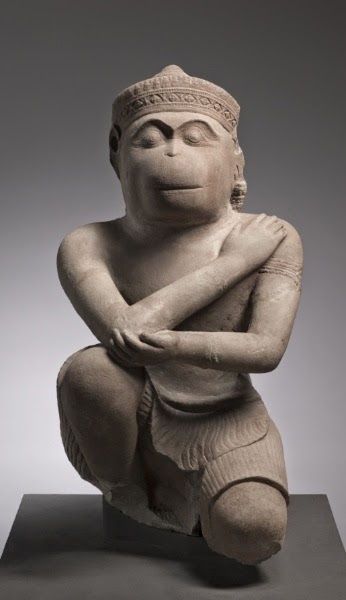
Last year saw several claims by Cambodian officials in respect of art they allege was looted from Cambodia during the Khmer Rouge regime. One of the claims was to a statue in the Cleveland Museum of Art collection, which the Cambodian cultural authorities say was looted from Prasat Chen, a 1000-year-old temple about 75 miles northeast of the better known Angkor Wat.


This month, the Cleveland Museum announced that after lengthy investigations they have determined that the statue is not from from Prasat Chen.

The Plain Dealer reports:
During the winter, the museum sent curator Sonya Rhie Quintanilla to Prasat Chen, a site of temple ruins 180 miles northwest of Phnom Penh.  
Based on her research, the museum said it has ruled out Prasat Chen as the sculpture's original location, although it said it could not rule out the possibility that it may been removed illegally from some other site.  
To check whether the work came from Prasat Chen, Quintanilla, the museum's curator of Indian and Southeast Asian art, carried in her luggage a lightweight plastic resin facsimile of the base of the Cleveland sculpture.  
When she reached the site, where a thousand-year-old temple features sculptures that narrate Hindu legends, she said she found that the facsimile did not fit the two spots where the museum's Hanuman sculpture logically might have been located.
While perhaps some kudos to the museum for doing some homework, is it really sufficient to say that the statue was not looted because it doesn't fit onto a particular base? I would have expected the museum to concentrate on proving the statue's provenance by reference to its ownership history. Who sold it to the museum? What background checks were performed? etc.

And, granted, the museum is said to be looking into this too. Nevertheless, it seems a bit premature to say the statue is not from Cambodia based on....essentially...a base.


Source: The New York Times, 20 May 2013, The Plain Dealer, 13 May 2014

Thursday, 22 May 2014

Dutch collections include art looted during World War II

It has been reported that the art collections of the Palace Het Loo, the Rijksmuseum and three other museums are thought to include pieces and artifacts that were looted from a Jewish family during World War II.

The NL Times explains that:
In total, 15 pieces of a valuable Meissen porcelain dinnerware ware set may have been stolen from the Gutmann family. The items may have been put up for auction in 1934 under coercion from the Nazis.

Now, 80 years after the fact, Amsterdam investigation bureau Artiaz was able to trace the pieces, to the museums...
Artiaz traced the dinnerware set pieces by looking through old auction documents... 
The items are part of a unique 435-piece Meissen dinnerware set depicting village scenes, which was given to Willem V around 1774 as a gift from the United East-Indian Company. The prince sold the set during exile in England.
Artiaz also said that it was controversial that the Ekkart Committee, which was appointed on 1 April 1999 to supervise the provenance research carried out on works of art confiscated during World War II and repatriated to Holland from Germany after the war (the "NK Collection"), failed to identify that the pieces had been looted. However, with the continual stream of new claims over artworks which were stolen from Jewish families during World War II, perhaps this is the least surprising aspect of the story.

Source: NL Times, 14 May 2014.

Wednesday, 21 May 2014

Not an easy snatch and grab

A thief managed to make off with a piece of a copper sculpture as it was being installed in a New York park.

The piece was part of an exhibition of Vietnamese artist Danh Vo's work "We the People", organised by the Public Art Fund. We the People is a life-size replica of Frédéric Auguste Bartholdi’s Statue of Liberty, recreated by Danh Vo in about 250 individual pieces.
One part of We the People
MyFoxNY reports that the robbery took place last week in City Hall Park - one of the locations of the exhibition, which was due to open on 17 May. The piece taken was a large, chain link section made of copper resembling a portion of the Statue of Liberty's foot. It is said to weigh about 40lbs and be worth about $6,000.

It does not appear that the theft has impacted on the opening of the exhibition, which can now be seen in both City Hall Park and Brooklyn Bridge Park. The police are investigating.

More details on the exhibition can be found here.

Monday, 10 February 2014

Nazi looted painting returned

Another painting which was seized by the Nazis during World War II [an unfortunately very familiar scenario] has been returned to Poland [a not-so-usual result].


After almost 6 years of investigations, the US Immigration Customs and Enforcement's Homeland Security Investigations (HSI) announced the return of "Saint Philip Baptizing a Servant of Queen Kandaki" by German artist Johann Conrad Seekatz on 6 February 2014. On the same day, a ceremony was held to officially hand the paining back to Poland.

HSI's press release detailed their investigations:
In June 2008, HSI New York special agents were notified by the Consulate General of the Republic of Poland that several national treasures of their cultural heritage looted during World War II were being offered for sale in the United States. 
HSI New York agents met with Polish officials who provided supporting documentation to assist in the identification and recovery of the looted Polish work of art. HSI agents initiated an investigation and identified that the painting came into the possession of Doyle New York Auctioneers and Appraisers in about October 2006 and was sold under its erroneous name for approximately $24,000 to Rafael Valls Gallery in London. 
An expert from the National Museum in Warsaw, delegated by the Polish Ministry of Culture and National Heritage, examined the painting in London with the full cooperation of the Rafael Valls Gallery and it was determined to be the same painting that was looted from Warsaw in 1944. In April 2012, HSI received an evaluation of the painting from the Ministry that the painting was identified as its true name and artist... 
On July 12, 2012, after learning the painting was stolen, it was seized by HSI agents from the London gallery by stipulation order with the assistance of the US Attorney’s Office for the Southern District of New York (SDNY). The painting was returned to New York from London leading to the Feb. 6 repatriation to the Republic of Poland.br />
Three other looted artworks were previously returned to Poland in 2010 and 2011. It remains to be seen if there will be others.

The Polish Ministry of Culture and National Heritage runs an on-line database which details the country's wartime losses. There are thousands of artworks which are still missing.

Read the full HSI press release here. 

Wednesday, 18 September 2013

Sotheby's battles US Government over Cambodian statue

Another update, this time to the Cambodian art dispute reported here.

By way of reminder, in August 2011, the US government intervened in a claim by the Cambodian government in respect of an ancient sandstone statue that was listed for auction by Sotheby's. Sotheby's then withdrew the statue from sale.

In a latest development, both sides to the dispute have filed motions with the US District Court in Manhattan accusing the other of unethical behaviour.

On it's side, Sotheby’s is accusing the US government of intervening in their negotiations to sell the statue in a private deal which would have allowed for the return of the statue to Cambodia. Their claim is that the government blocked the deal as it wanted all the credit for the statue's return.

Meanwhile, the prosecutors have accused one of their former colleagues,  Jane A. Levine, who now works for Sotheby's, of providing them with “false and misleading information” in relation to the statue.

Sotheby's, additionally, filed further evidence disputing the ability of the US government to bring the case, and asked the judge to defer the further exchange of discovery until the court has ruled on on its motion to dismiss the case.

The court has set the next hearing for 14 October.

Source: The New York Times, 13 September 2013

Tuesday, 17 September 2013

Update: Kunsthal loot and blue suede shoes

By way of latest news in relation to the saga of the paintings stolen from the Kunsthal gallery (reported here, here and here), where the lawyers for the accused had said that the paintings had not been destroyed and could be returned, now they have said that the accused thieves will not reveal where the works have been hidden following the refusal by the Romanian court of a request for the case to be tried in the Netherlands.

Bloomberg reports that at a pretrial hearing in Bucharest for the trial of Radu Dogaru, the alleged ringleader, his lawyer said that 'his client was trying to avoid a more-stringent sentence in his homeland by offering to return the five under his "control" in exchange for being transferred to Holland and, if convicted, serving his time there'.

Don't you criticise my shoes
Before the court could deal with this issue, however, there was apparently several hours of debate as to what it should do about the shoes of one of the lawyers for the accused. The man in question had reportedly made the sartorial decision to wear blue suede sneakers with florescent green stripes to court, which, understandably, enraged the judge. Ignoring the lawyer's protestations that the shoes were expensive and highly fashionable, and that the judge was clearly biased and should be replaced, the judge declined to replace himself and fined the lawyer 5,000 lei ($1,488).

Meanwhile, the Dutch foundation that managed the stolen pieces, seemingly despaired by the on-going saga, has given up on ever recovering the paintings, recovering €17 million from its insurers, and accordingly surrendering its ownership rights to the paintings.

Sources: Bloomberg, 10 September 2013, The New York Times, 10 September 2013

Friday, 23 August 2013

Sotheby's sells stolen art

It appears that Sotheby's London sold a piece of art at auction at the end of June for over £180,000, despite having been informed by the Art Loss Register (ALR) that it was stolen.
The piece by Jan Schoonhoven, R69-32 (1969), was originally stolen from the Bommel van Dam museum in March this year (along with two other Schoonhoven works and a piece by Tomas Rajlich). The work was reportedly simply turned 90 degrees, and its name was slightly altered. This was apparently all that was needed to fool everyone...

Upon discovering that the piece was up for auction, the ALR, who had been alerted when the work was stolen, contacted Sotheby's and told them that it corresponded to a Schoonhoven relief in their database. Sotheby's response was that as the title of the work did not correspond to the title in the ALR database. Therefore, they proceeded to sell the piece at auction on 27 June to two art galleries who bought it together - the Mayor Gallery in London and the Borzo in Amsterdam.

It is reported that it was only when Paul van Rosmalen from the Borzo, who had been away when the work was purchased, became aware of the acquisition made in his absence that questions were raised. An expert on Schoonhoven, he found it strange that the work had been put up for sale and asked for more details from his London colleagues. Van Rosmalen said that, on review of the photos they sent him, it was very clear that the title of the work had been modified (from R69-32 to R69-39). The sale was then immediately annulled and an enquiry opened.

The whole affair, however, only became public last week, when it was reported that a man entered a police station in Amsterdam in possession of the two other Schoonhoven reliefs stolen at the same time. On questioning, he claimed to have bought the three works in good faith...for €100...and admitted selling one through Sotheby's.

But all is well that ends well...almost. The two works which were turned into the Dutch police have been returned to the Bommel van Dam museum, although the auctioned work is apparently still in London. Unfortunately the piece by Tomas Rajlich is still missing.

Source: Le Quotidien, 23 August 2013

Wednesday, 14 August 2013

Did They or Didn't They?

In a further update to the case of the masterpieces stolen from the Kunsthal gallery and potentially destroyed, lawyers for the accused now claim that the paintings have not been destroyed and could be handed back to the Dutch authorities.

The reports vary, however it seems that accused are hoping to use the paintings to in some way broker a deal with the court.

The court in Bucharest, where the trial of those accused is taking place, has presently adjourned the case until 10 September 2013. This is reportedly to allow certain several issues to be further examined.

Thursday, 25 July 2013

Refired art

As an update to my post on the potential destruction of the paintings from the Kunsthal gallery in Rotterdam, I have been alerted to an interesting post on The 1709 Blog looking at whether the law provides any remedy to such acts. The post, composed by Mira T. Sundara Rajan, can be found here.

Wednesday, 24 July 2013

Art to Ashes

Last October, thieves broke into the Kunsthal gallery in Rotterdam and stole seven extremely valuable paintings off the walls.

The thieves took the following works:

Pablo Picasso's Harlequin Head
Claude Monet's Waterloo Bridge, London
Claude Monet's Charing Cross Bridge, London
Henri Matisse's Reading Girl in White and Yellow
Paul Gauguin's Girl in Front of Open Window
Meyer de Haan's Self-Portrait
Lucian Freud's Woman with Eyes Closed
It now, horrifyingly, appears that these works of art may have been burnt in an attempt to destroy the evidence of the crime.

By way of background, three Romanians were arrested in January 2013 on suspicion of having stolen the paintings, however these were not found. Subsequently, Olga Dogaru, the mother of one of those charged with stealing the paintings, claimed that she had buried the paintings in an abandoned house, but later dug up the art and burned them after police began searching the village for the stolen works.

The Associated Press now reports that forensic experts have determined that ash from Dogaru's oven contained "'small fragments of painting primer, the remains of canvas, the remains of paint' and copper and steel nails, some of which pre-dated the 20th century." But that "Ernest Oberlander-Tarnoveanu, director of Romania's National History Museum...refused to say definitively that the ashes were from the stolen paintings. He said justice officials would make that decision. He did venture, however, that if the remains were those of the paintings, it was 'a crime against humanity to destroy universal art'."

The Associated Press explains that the next step will be to compare the ashes to what was known about the missing paintings to determine if the remnants are consistent with the stolen works. Let's hope by some miracle that they are not.

Source: Associated Press, 17 July 2013

Monday, 3 June 2013

Due regard for diligence

As a lawyer, due diligence is certainly one of my least favourite activities, but I accept that it can sometimes be crucial. This weekend, the Observer highlighted the importance of carrying out sufficient due diligence on potential art sales. It also emphasised the effectiveness of the Art Loss Register (ALR), which I discussed here back in 2010.

The Observer reports:
European auction houses, dealers and collectors are failing to make adequate checks to avoid handling stolen artworks, an art lawyer has warned after recovering from an Italian auction an old master painting taken from its British owner in a burglary more than 30 years ago.
Christopher A Marinello [the ALR's general counsel], who specialises in recovering stolen art and resolving title disputes, said: "We do find a lot of stolen and looted artwork in civil law countries such as Italy, France and Germany. Consigners of tainted works of art often try to hide behind the good-faith purchase laws of these countries while performing little or no due diligence."
He spoke to the Observer after negotiating the return from Italy of a landscape painting by Jan van Goyen, a 17th-century Dutch painter, which was stolen in 1979. Negotiations were particularly delicate because, under Italian law, if someone buys a stolen work in good faith the buyer is sometimes entitled to keep it. Marinello was able to prove to the Italian auctioneer that the painting was one of nine pictures stolen at night by criminals who broke into the home of Paul Mitchell, an antique picture frame specialist in London.
...
[Marinello said]: "The Italian auction house involved did not search the work with the ALR, but the dealer did. While losing out on a potential future sale, the [dealer] protected his reputation and saved himself significant sums in legal fees defending a case over title to the painting." Unless more dealers, collectors and auctioneers make such checks, he added, other stolen items will remain undetected. "It's the same concept as having a survey done prior to purchasing a home. Considering the values involved, why wouldn't you want to know if there were serious title issues before purchasing fine art?"

Source: The Observer, 1 June 2013

Monday, 15 October 2012

US Court of Appeal rejects Nazi theft claims

The US Court of Appeals for Second Circuit last week affirmed in its entirety the judgment of the District Court in relation to an ownership dispute concerning this 1917 drawing by Egon Schiele known as Seated Woman With Bent Left Leg (Torso):


As we reported here, the case was brought by David Bakalar who sought a declaration that he was the lawful owner of the work having purchasing it from a dealer.

On the other side, were Milos Vavra and Leon Fischer who were the heirs to Fritz Grunbaum, a prominent Austrian Jewish art collector, who owned the work before he was murdered by the Nazis in 1941. Vavra and Fischer claimed in the alternative that either (i) the work had been stolen by the Nazis after Grunbaum's arrest in Vienna in 1938 or (ii) the drawing had been stolen from the Grunbaum estate.

The District Court for the Southern District of New York awarded judgment to Bakalar on the basis of laches. In this respect, the Court noted that Vavra and Fischer ancestors' were aware of, or should have been aware of, their potential intestate rights to Grunbaum's property, and were not diligent in pursuing their claims to the work, which meant that Bakalar was Prejudiced in his ability to garner evidence to vindicate his rights in the work. The District Court also found that was not looted by the Nazis.

Vavra and Fischer appealed on the basis that that the District Court committed two errors of law bearing on the laches defense and challenged the finding that Bakalar was prejudiced by their ancestors’ delay in pursuing the work.

The Court of Appeals rejected the appeal in full finding no merit in Vavra and Fischer’s arguments. It held that there was no clear error in the findings that Vavra and Fischer’s ancestors knew or should have known of a potential claim to the Drawing, that they took no action in pursuing it, and that Bakalar was prejudiced in the litigation as a result of that delay. It was therefore sound to recognize Bakalar’s title on the basis of his laches defense.

This is an important decision for the New York art market which favours the rights of dispossessed former owners over the rights of good faith purchasers of stolen property, to ensure there is a balance between both parties' rights. Claims can be made by dispossessed owners, but they need to be made in good time in order not to prejudice the purchasers' ability to defend their rights.

The decision of the US Appeals Court can be found here.

Thursday, 30 August 2012

Cambodian art dispute

Last week saw the latest step in an art dispute between Cambodia and Sotheby's.

The dispute concerns a 10th century sandstone statue. Sotheby's listed the statue for auction on 24 March 2011.


The press release noted that the auction of Indian & Southeast Asian Works would "be led by a spectacular 10th century Khmer Koh Ker period Athlete from a European private collection (est. $2/3 million). Acquired by the original owner over 40 years ago, the figure is mate to the Koh Ker athlete at the Norton Simon Museum in Pasadena that is almost identical in posture and physical appearance." Indeed, it is reported that in 2007, archaeologists were able to match the statue to its pedestal at a temple site in Koh Ker, a temple complex 60 miles northeast of the more well-known Angkor Wat.

At the last minute, however, the statue was removed from the auction following a claim from the Cambodian government that it had been illegally removed from Cambodia during the reign of the Khmer Rouge and should be returned to the country. Subsequently, following a request from Cambodia, US federal prosecutors filed a forfeiture claim on Cambodia's behalf. Then, in June of this year, Sotheby’s filed an unsuccessful motion to dismiss the claim on the grounds that there was no evidence that the statue had been stolen from Cambodia.

Most recently, on 21 August 2012, evidence was filed that accused Sotheby’s of knowing that the sculpture had been stolen from Cambodia when it put the work up for auction in March 2011. In this respect, the New York Times reports that:
"In their new filing, the prosecutors included statements from two heritage law experts who said that, under Cambodian and British law, the statue should be treated as stolen property.
One expert, Matthew Rendall, said the statue is covered under Cambodian statutes, royal orders and decrees dating to the early 1900s that declare such items to be the “exclusive” and “immovable” property of the government. Mr. Rendall noted five occasions between 1985 and 1997 when Sotheby’s returned sculptures to Cambodia after claims they had been looted sometime after 1970.
Sotheby’s says the sculpture could have been spirited away any time during its thousand-year history and was bought in good faith by the husband of its current owner in 1975 from a London dealer.
Experts cited by the United States and Cambodian governments insist the statue was removed more recently. The say it was too remotely located and too heavy – more than 600 pounds — to have been carried off until adequate roads were built into the region sometime after 1960."
Disputes over ownership of looted artworks are not new. However, the decisions do go either way. It remains to be seen whether the statue will be returned to Cambodia. If it can be shown that Sotheby's knew that the statue was stolen, there is a good chance that the US attorney's claim will be successful. But, it is unlikely to be very easy to prove Sotheby's knowledge. Perhaps a better standard, in any case, is whether Sotheby's ought to have known. As one of the world's largest art auctioneers, it is difficult to believe that Sotheby's did not question the origin of the statue when it was offered to them for sale.

Source: The New York Times, 21 August 2012

Saturday, 21 April 2012

Stolen art returned

It is not often easy to predict which way decisions in respect of Nazi stolen art will go, so some good news from the Courthouse News Service.

This week, the US government returned the 400 year old painting of "Cristo Portacroce" (Christ Carrying the Cross) by Italian artist Girolamo Romano to the family of former owner, Federico Gentili di Giuseppe.


Giuseppe had purchased the painting at the beginning of the 20th century. However, when he died in 1941, in Nazi-occupied France, his estate was auctioned off and his heirs were prohibited from claiming the painting due to the anti-Semitic laws in place at the time. As a result, the painting was illegally sold in a forced sale in 1941.

The Courthouse News Service reports that:

Giuseppe's grandchildren reached a watershed moment in their efforts to reclaim the artwork in 1999, when the Paris Court of Appeals forced the Louvre to return five paintings in a landmark decision for World War II plunder.

In March 2011, "Christ Carrying the Cross" was imported into the U.S. for a temporary exhibit at the Mary Brogan Museum of Art and Science in Tallahassee, Florida.

On a lead from Interpol, the U.S. Attorney's Office seized the painting months later and returned it to Giuseppe's heirs…


Source: Courthouse News Service, 19 April 2012

Friday, 9 September 2011

Hungary can be sued for return of Nazi looted art

Last week, the United States District Court for the District of Columbia (DDC) rejected Hungary's motion to dismiss a claim brought against it by the heirs of Baron Mor Lipot Herzog, a well-known Jewish Hungarian art collector.

Herzog had amassed a large collection of more than 2000 paintings, sculptures and other artworks prior to his death in 1934. After his death, and the death of his wife in 1940, his collection was divided among his three children. However, the collection was then seized by Hungary and Nazi Germany, and while the Hungarian government purported to “return” a handful of items from the collection to the Herzog heirs in the years immediately following the war, those “returns” were largely on paper or short-lived, and the vast majority of the collection remained in the possession of a number of museums and other Hungarian state-owned bodies.


One of the pieces claimed in the action.


Having unsuccessfully tried to reclaim the collection through the Hungarian courts, the plaintiffs [claimants in the UK] filed the action in the DDC in July 2010 against the Republic of Hungary, the Hungarian National Gallery, the Hungarian Museum of Fine Arts, the Hungarian Museum of Applied Arts and the Budapest University of Technology and Economics.

On 15 February 2011, the defendants filed a
motion to dismiss the claim on a number of grounds including:

  • the Court lacked jurisdiction under the Foreign Sovereign Immunities Act;
  • the Court was an improper forum for the claims based on the 1973 Agreement between Hungary and the United States; and
  • the claims were barred by the applicable statute of limitations; principles of international comity, claim preclusion, and issue preclusions; and the Act of State Doctrine.

    Unfortunately for the defendants, the DDC rejected all these grounds and, for the most part, denied the defendants' motion. In respect of the ground listed above, the court inter alia held as follows.

    Jurisdiction
    In order to have jurisdiction, the Court had to find that: (1) “rights in property” are at issue; (2) the property was “taken in violation of international law”; and (3) “the property at issue (or any property exchanged for it) [is] . . .‘owned or operated by an agency or instrumentality of the foreign state and that agency or instrumentality’ engages in commercial activity in the United States”.

    The Court found that (1) the defendants did not dispute that “rights in property" (2) the plaintiffs’ claim that the Herzog Collection was taken in violation of international law was substantial and non-frivolous, and therefore, adequately satisfied the second requirement; and (3) the defendants admitted that the museums and the university (both agencies or instrumentalities of Hungary) were in possession of the pieces of collection identified in the complaint which was sufficient to satisfy the ‘owned or operated’ requirement, ad these bodies were are engaged in “either a regular course of commercial conduct or a particular commercial transaction or act” in the US as of the commencement of the action.

    Improper forum
    The 1973 Agreement did not strip the court of jurisdiction.

    Barred claims
    The defendants’ claim to forum non conveniens ground was not established.

    The Complaint stated facts which, if true, could support a finding that the action was timely, and so was not barred by the applicable statute of limitations.

    The balance of factors weighs against applying the act of state doctrine (which precludes the courts of a country from inquiring into the validity of public acts of a recognised foreign sovereign power committed within its own territory).

    There were no grounds for dismissing the case on the political question doctrine (which instructs that courts should decline to adjudicate matters which have in any measure been committed by the Constitution to another branch of government).

    The claims were not barred by the doctrine of international comity (that the merits of the case should not, in an action brought in this country upon the judgment, be tried afresh, as on a new trial or on appeal, upon the mere assertion of the party that the judgment was erroneous in law or in fact).

    It is assumed that the case will now proceed to trial and a decision on the merits. However, this preliminary
    decision is a very worthwhile read. Particularly, on the historical aspects of Hungary during and after the Second World War.

  • Monday, 25 July 2011

    Cornered by his art?

    Last week, after years on the run, one major Croatian Serb war criminals Goran Hadzic was arrested. Hadzic has been charged and found guilty in absentia by the International Criminal Tribunal for the former Yugoslavia for crimes he committed under the leadership of Slobodan Milošević between June 1991 and December 1993, including the persecution and murders of thousands Croats and other non-Serbs.

    Reuters reports that it was actually a stolen painting by Modigliani that lead to his capture:
    A stolen painting said to be by Italian figurative artist Amedeo Modigliani gave prosecutors an essential clue in finding Hadzic, Serbia's war crimes prosecutor said.
    "The breakthrough was information that he (Hadzic) wanted to sell a stolen Modigliani painting as he was running out of money," Vladimir Vukcevic told a news conference.

    It is still unclear however whether the painting, believed to be “Portrait of a Man” by Modigliani (pictured here), is authentic – although the Art Loss Register (which I wrote about here) does list four Modiglianis as stolen. However, whether it is or not, the painting has already proven itself invaluable in bringing a major criminal to justice. The recovery of the stolen art would just be an added [multi million pound] benefit.


    Source: Reuters, 20 July 2011

    Friday, 24 June 2011

    No innocent owner defence for stolen art as US court orders return of painting to France

    In a recent decision of the United States Court of Appeals Second Circuit, another innocent buyer of a stolen painting has had to forfeit the work to the original owner from whom the work was stolen.

    The painting in question is “Le Marché,” by Camille Pissarro, which was one of two paintings stolen from the Musée Faure in Aix–les–Bains, France on November 16, 1981.
    By way of background, in 1985, the claimant/appellant, Sharyl R. Davis purchased the painting at fair market value from J. Adelman Antiques and Art Gallery, to whom the thief had consigned the work, unaware that it had been stolen, and it was only twenty years later, when Davis consigned the work to Sotheby's for sale at auction that the painting's provenance came to light. At this point, the French police became aware of the impending sale and informed US law enforcement officials that the painting had been stolen twenty-two years earlier. The US Department of Homeland Security thus requested that Sotheby's withdraw the painting from auction, and following the compilation of evidence to substantiate the theft, the US government filed a complaint in the Southern District of New York in November 2006 seeking forfeiture of the painting in order to return the work to France.

    On 19 January 2010, the district court gave its judgment in favour of the US government and ordered forfeiture. Davis appealed and the 2nd US Circuit Court of Appeals was required to hear the matter. Davis argued that the government had failed to demonstrate probable cause under the applicable US law, namely, 19 U.S.C. § 1595a and the National Stolen Property Act.

    Under section 1595a, merchandise “introduced into the United States contrary to law,” may be subject to forfeiture if that property “is stolen, smuggled, or clandestinely imported or introduced.” To satisfy the “contrary to law” requirement, the government alleged that the thief had violated the NSPA by stealing Le Marché from the Musée Faure back in 1981, transporting it into the United States, and then consigning it to Adelman. Davis submitted that the district court committed three errors in its application of the NSPA. Firstly, Davis argued, “contrary to law” referred only to violations of the customs laws, not to violations of the NSPA. Second, Davis said that the district court erred in granting summary judgment to the government on whether Le Marché's value met the NSPA's statutory minimum of $5,000. Finally, Davis argued, Le Marché was no longer “stolen” property within the meaning of Section 1595a(c), and was therefore not subject to forfeiture.

    Unfortunately for Davis, the Court rejected each argument. In particular, in relation to Davis claim that she should have been allowed to assert an innocent owner defence, the court noted: 
    • The statute states that property introduced into the U.S. contrary to law "shall" be forfeited.
    • Use of the word 'shall' “indicated that Congress intended forfeiture under §1595a(c)(2) to happen as a matter of course.
    • Such definite language was not susceptible to an interpretation that a legitimate possessory interest in the property might defeat an otherwise valid forfeiture claim.
    • It was unsurprising that the law — enacted more than eighty years ago — would require forfeiture of property regardless of the owner's culpability.
    • Early statutes used to enforce the customs laws․ generally, contained no innocent owner defence. Historically, the owner of forfeited property could be entirely innocent of any crime, and, indeed, the Supreme Court had held, in a case addressing another provision of the Tariff Act of 1930, that “forfeiture may be enforced even against innocent owners․ The penalty is at times a hard one, but it is imposed by the statute in terms too clear to be misread.”
    This judgment is an important reminder of requirement for sound due diligence in the purchase of art. Not only did Davis have to pay the costs of a drawn out court action, but she also lost the benefit of her long term investment.

    Read the full decision here.

    Monday, 16 May 2011

    Ay Ay - time for an update?

    With the members of the A&A team in various national and international manoeuvres, the “latest” in art and law has become the “most recent”. Therefore, it seemed like a good time for an update of all such recent news.

    Ai Weiwei still missing

    Firstly, by way of update, following on from my report here, there has still been no sign of Ai Weiwei since he was detained at Beijing airport at the beginning of April.

    Still little information is available. All the police have said is that he is under investigation for economic crimes. However, his family have not been notified of his detention, as is said to be usual.

    It is worth remembering that such blatant violations of basic human rights continue to take place around the world.

    Meanwhile in the Forbidden City

    A man has been arrested after thieves managed to break in and steal several pieces of art from a temporary display in a museum in the Forbidden City in Beijing. A couple of pieces were subsequently recovered nearby, however it does not appear that the arrest has lead to the recovery of the rest of the works.

    While the Forbidden City will now no doubt bulk up their security, because the works in question were on loan from the Liang Yi Museum in Hong Kong, it remains to be seen is whether the incident nevertheless has an effect on art works being loaned to China by foreign galleries and museums.

    New Nazi art recovery website

    Another tool to assist in the recovery of cultural property that was stolen, looted, seized, forcibly sold, or otherwise lost during the Nazi-era has been launched.

    In addition to the tools discussed here, here and here, further to the international collaborative efforts of the UK National Archives, the French Diplomatic Artive Center, the Central State Archive of Ukraine, the Belgian State Archives, the Commission on Looted Art in Europe, the Claims Conference, the US Holocaust Museaum, the US National Archives, the German Historical Museum and the Federal German Archives, records of artworks are now available through the International Research Portal.

    The collaboration is was established to fulfill the 1998 Washington Conference Principles on Nazi-Confiscated Art, the 2000 Vilnius Forum Declaration and the 2009 Terezin Declaration, in particular on the importance of making all records of Nazi-confiscated art publicly accessible.

    Let us hope that the portal improves the location and return of looted and/or lost art to its rightful owners.

    A success story

    Last month a holocaust survivor had a Gustav Klimt painting, that had belonged to his grandmother before she was arrested by the Nazis and deported to a concentration camp during the Second World Warm, returned.

    Back in 1941, Georges Jorisch's grandmother had a collection of Klimt paintings which were seized after her arrest. Jorisch tracked one of those paintings, Litzlberg am Attersee, to the Salzburg Museum which had acquired it in 1944.

    In quite a rare move, of which there are unfortunately not enough, the museum accepted that the painting should be returned to its rightful owner.

    Origami copyright case

    An anonymous reader has helpfully alerted me to an interesting complaint filed, at the end of April 2011 in the US District Court of the Northern District of California by a group of six artists seeking damages for copyright infringement from another artist.

    The plaintiffs claim to be experts in origami, and it is the copyright in their origami models that they allege has been infringed. Specifically, it is claimed that the so-called “crease patterns” created and published by the plaintiffs for their some of their origami models have been copied. As the complaint explains: “The lines of a crease pattern represent the folds needed to create a three-dimensional origami model from a sheet of paper, but the intricacy of these geometric diagrams gives crease patterns their own aesthetic appeal. Crease patterns thus lend themselves to derivative works, such as colorized versions.”

    The defendant is Sarah Morris, an internationally known painter and film maker, who debuted a set of 37 paintings entitled the “Origami series” in 2007, which has now been exhibited around the world. A plaintiffs allege that a large number of the Origami series painting are based on their origami designs and Morris has merely transferred the crease patterns to canvas and applied paint to the spaces between the lines.

    Comparisons of the crease patterns and Morris' works are exhibited to the complaint, and include the following:


    More examples can be found
    here.

    Any thoughts on the merits of the claim? Do the origami artists have a good claim?