Showing posts with label looting. Show all posts

Friday, 23 May 2014

Cambodia to Cleveland?

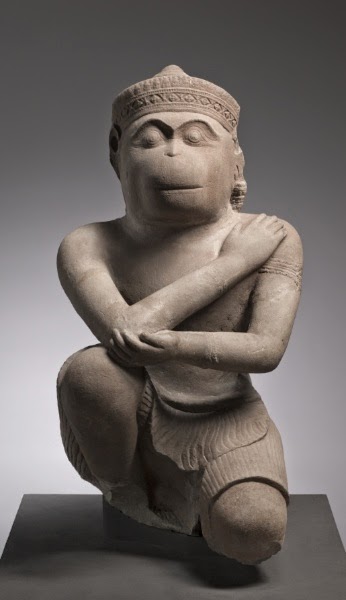
Last year saw several claims by Cambodian officials in respect of art they allege was looted from Cambodia during the Khmer Rouge regime. One of the claims was to a statue in the Cleveland Museum of Art collection, which the Cambodian cultural authorities say was looted from Prasat Chen, a 1000-year-old temple about 75 miles northeast of the better known Angkor Wat.


This month, the Cleveland Museum announced that after lengthy investigations they have determined that the statue is not from from Prasat Chen.

The Plain Dealer reports:
During the winter, the museum sent curator Sonya Rhie Quintanilla to Prasat Chen, a site of temple ruins 180 miles northwest of Phnom Penh.  
Based on her research, the museum said it has ruled out Prasat Chen as the sculpture's original location, although it said it could not rule out the possibility that it may been removed illegally from some other site.  
To check whether the work came from Prasat Chen, Quintanilla, the museum's curator of Indian and Southeast Asian art, carried in her luggage a lightweight plastic resin facsimile of the base of the Cleveland sculpture.  
When she reached the site, where a thousand-year-old temple features sculptures that narrate Hindu legends, she said she found that the facsimile did not fit the two spots where the museum's Hanuman sculpture logically might have been located.
While perhaps some kudos to the museum for doing some homework, is it really sufficient to say that the statue was not looted because it doesn't fit onto a particular base? I would have expected the museum to concentrate on proving the statue's provenance by reference to its ownership history. Who sold it to the museum? What background checks were performed? etc.

And, granted, the museum is said to be looking into this too. Nevertheless, it seems a bit premature to say the statue is not from Cambodia based on....essentially...a base.


Source: The New York Times, 20 May 2013, The Plain Dealer, 13 May 2014

Friday, 18 October 2013

Looted Klimt claim

We have not had a post about looted Holocaust art for a while.

We have previously reported on the return of artworks seized by the Nazis, including paintings by Gustav Klimt.

This week comes the news that a new claim has been filed in Austria in relation to another Klimt work, the Beethoven Frieze.

A section of the Beethoven Frieze (1902)
This claim, however, relates not to the return of the work per se, but rather the effect of former Austrian law on those who reclaimed the work.

The New York Times explains:
The gold-painted frieze was owned by the Lederer family, wealthy Austrian Jews who were important patrons of Klimt’s. When the Nazis invaded Austria in 1938, the family escaped to Switzerland, but its extensive art collection was seized and its once formidable industrial empire bankrupted. Many of the family’s valuable works, including 18 Klimts, were destroyed in the final days of the war. 
The mammoth frieze survived and was formally returned to Erich Lederer, the family heir, after the war. But there was a hitch. The Austrian government would grant him export licenses for his other artworks only if he sold the “Beethoven Frieze” to the state at a cut-rate price, Mr. Lederer’s heirs say.

In a 1972 letter to Bruno Kreisky, then the Austrian chancellor, Mr. Lederer complained about what he considered government extortion, writing that officials were “trying to force me to my knees” and thinking “why won’t he finally die, this LEDERER!” 
Mr. Lederer finally agreed to sell the frieze to the government in 1973 for $750,000: half of its estimated worth at the time, according to an evaluation by Christie’s. Since 1986, it has been on view at the turn-of-the-century Secession gallery, where it was first shown at a 1902 exhibition named after Klimt’s breakthrough art movement. 
Georg Graf, a law professor and restitution expert at the University of Salzburg, who is supporting the family’s claim, said, “While the Austrian Republic did formally return the artwork after the war, it ultimately forced Erich Lederer to sell it back in old age by upholding the export ban.”
In 2009, the Austrian government amended its restitution law to apply to property that was sold at a discount because of that ban. 
It is under this law that the Lederer family filed its claim on Tuesday to the government’s Art Restitution Advisory Board. This panel will, in turn, make a recommendation about the “Beethoven Frieze” to the Austrian minister for education, the arts and culture, Claudia Schmied, who is to make the final decision. 
This looks like it is going to be one of the more significant cases brought under the new law.


Source:  The New York Times, 15 October 2013

Tuesday, 20 August 2013

Egyptian Art Ravaged

Back in 2011, the political and civil unrest in Egypt led to the destruction and theft of numerous artworks (reported here).

With the continuing turmoil over there, it appears that the same thing is happening once more. Russia Today reports:
As Egypt plunges deeper into the political turmoil, looters take advantage of the situation – and the latest robbery of the Malawi Museum in the city of Minya, 300km from Cairo, has been the biggest of its kind in the Egyptians’ living memory.  
Looters got away with more than 1,000 objects, including a prized 3,500-year-old limestone statue, ancient beaded jewelry, gold and bronze Greco-Roman coins, pottery and bronze-detailed sculptures of animals sacred to Thoth, one of the ancient Egyptian deities represented with the head of an ibis. 
The building was initially vandalized last Wednesday, with looting and burning going on for almost a week now. Local teenagers burned and destroyed mummies and other objects of art which were too heavy for robbers to carry.  
This is reportedly the biggest museum theft in Egyptian history. It is terrible to hear, yet again, about the destruction of these invaluable artworks.

Source: Russia Today, 20 August 2013

Thursday, 30 August 2012

Cambodian art dispute

Last week saw the latest step in an art dispute between Cambodia and Sotheby's.

The dispute concerns a 10th century sandstone statue. Sotheby's listed the statue for auction on 24 March 2011.


The press release noted that the auction of Indian & Southeast Asian Works would "be led by a spectacular 10th century Khmer Koh Ker period Athlete from a European private collection (est. $2/3 million). Acquired by the original owner over 40 years ago, the figure is mate to the Koh Ker athlete at the Norton Simon Museum in Pasadena that is almost identical in posture and physical appearance." Indeed, it is reported that in 2007, archaeologists were able to match the statue to its pedestal at a temple site in Koh Ker, a temple complex 60 miles northeast of the more well-known Angkor Wat.

At the last minute, however, the statue was removed from the auction following a claim from the Cambodian government that it had been illegally removed from Cambodia during the reign of the Khmer Rouge and should be returned to the country. Subsequently, following a request from Cambodia, US federal prosecutors filed a forfeiture claim on Cambodia's behalf. Then, in June of this year, Sotheby’s filed an unsuccessful motion to dismiss the claim on the grounds that there was no evidence that the statue had been stolen from Cambodia.

Most recently, on 21 August 2012, evidence was filed that accused Sotheby’s of knowing that the sculpture had been stolen from Cambodia when it put the work up for auction in March 2011. In this respect, the New York Times reports that:
"In their new filing, the prosecutors included statements from two heritage law experts who said that, under Cambodian and British law, the statue should be treated as stolen property.
One expert, Matthew Rendall, said the statue is covered under Cambodian statutes, royal orders and decrees dating to the early 1900s that declare such items to be the “exclusive” and “immovable” property of the government. Mr. Rendall noted five occasions between 1985 and 1997 when Sotheby’s returned sculptures to Cambodia after claims they had been looted sometime after 1970.
Sotheby’s says the sculpture could have been spirited away any time during its thousand-year history and was bought in good faith by the husband of its current owner in 1975 from a London dealer.
Experts cited by the United States and Cambodian governments insist the statue was removed more recently. The say it was too remotely located and too heavy – more than 600 pounds — to have been carried off until adequate roads were built into the region sometime after 1960."
Disputes over ownership of looted artworks are not new. However, the decisions do go either way. It remains to be seen whether the statue will be returned to Cambodia. If it can be shown that Sotheby's knew that the statue was stolen, there is a good chance that the US attorney's claim will be successful. But, it is unlikely to be very easy to prove Sotheby's knowledge. Perhaps a better standard, in any case, is whether Sotheby's ought to have known. As one of the world's largest art auctioneers, it is difficult to believe that Sotheby's did not question the origin of the statue when it was offered to them for sale.

Source: The New York Times, 21 August 2012

Friday, 9 September 2011

Hungary can be sued for return of Nazi looted art

Last week, the United States District Court for the District of Columbia (DDC) rejected Hungary's motion to dismiss a claim brought against it by the heirs of Baron Mor Lipot Herzog, a well-known Jewish Hungarian art collector.

Herzog had amassed a large collection of more than 2000 paintings, sculptures and other artworks prior to his death in 1934. After his death, and the death of his wife in 1940, his collection was divided among his three children. However, the collection was then seized by Hungary and Nazi Germany, and while the Hungarian government purported to “return” a handful of items from the collection to the Herzog heirs in the years immediately following the war, those “returns” were largely on paper or short-lived, and the vast majority of the collection remained in the possession of a number of museums and other Hungarian state-owned bodies.


One of the pieces claimed in the action.


Having unsuccessfully tried to reclaim the collection through the Hungarian courts, the plaintiffs [claimants in the UK] filed the action in the DDC in July 2010 against the Republic of Hungary, the Hungarian National Gallery, the Hungarian Museum of Fine Arts, the Hungarian Museum of Applied Arts and the Budapest University of Technology and Economics.

On 15 February 2011, the defendants filed a
motion to dismiss the claim on a number of grounds including:

  • the Court lacked jurisdiction under the Foreign Sovereign Immunities Act;
  • the Court was an improper forum for the claims based on the 1973 Agreement between Hungary and the United States; and
  • the claims were barred by the applicable statute of limitations; principles of international comity, claim preclusion, and issue preclusions; and the Act of State Doctrine.

    Unfortunately for the defendants, the DDC rejected all these grounds and, for the most part, denied the defendants' motion. In respect of the ground listed above, the court inter alia held as follows.

    Jurisdiction
    In order to have jurisdiction, the Court had to find that: (1) “rights in property” are at issue; (2) the property was “taken in violation of international law”; and (3) “the property at issue (or any property exchanged for it) [is] . . .‘owned or operated by an agency or instrumentality of the foreign state and that agency or instrumentality’ engages in commercial activity in the United States”.

    The Court found that (1) the defendants did not dispute that “rights in property" (2) the plaintiffs’ claim that the Herzog Collection was taken in violation of international law was substantial and non-frivolous, and therefore, adequately satisfied the second requirement; and (3) the defendants admitted that the museums and the university (both agencies or instrumentalities of Hungary) were in possession of the pieces of collection identified in the complaint which was sufficient to satisfy the ‘owned or operated’ requirement, ad these bodies were are engaged in “either a regular course of commercial conduct or a particular commercial transaction or act” in the US as of the commencement of the action.

    Improper forum
    The 1973 Agreement did not strip the court of jurisdiction.

    Barred claims
    The defendants’ claim to forum non conveniens ground was not established.

    The Complaint stated facts which, if true, could support a finding that the action was timely, and so was not barred by the applicable statute of limitations.

    The balance of factors weighs against applying the act of state doctrine (which precludes the courts of a country from inquiring into the validity of public acts of a recognised foreign sovereign power committed within its own territory).

    There were no grounds for dismissing the case on the political question doctrine (which instructs that courts should decline to adjudicate matters which have in any measure been committed by the Constitution to another branch of government).

    The claims were not barred by the doctrine of international comity (that the merits of the case should not, in an action brought in this country upon the judgment, be tried afresh, as on a new trial or on appeal, upon the mere assertion of the party that the judgment was erroneous in law or in fact).

    It is assumed that the case will now proceed to trial and a decision on the merits. However, this preliminary
    decision is a very worthwhile read. Particularly, on the historical aspects of Hungary during and after the Second World War.

  • Saturday, 29 January 2011

    Egyptian Museum Safe (for now)


    The Egyptian Museum houses a variety of priceless works of art, including the contents of the tomb of King Tutankhamen. The gold death mask is one of the most spectacular and famous pieces.


    It is unclear how many of the works are in the museum at the present time as reports suggest that a large number of treasures are currently on tour around the States, nevertheless, the quality and historical significance of the art stored in the museum cannot be underestimated.

    Unfortunately, the museum is practically next door to the National Democratic Party building which has been the focus of a lot of the fighting in Cairo.

    There were a variety of both alarming and reassuring reports yesterday. The Guardian suggested that the fire at the NDP headquarters might spread to the Museum. Meanwhile, Euronews reported that thousands of protestors had formed a human chain around the Museum to prevent its being looted.

    Reuters finally reported that the army had secured the Museum late last night. It appears to be safe for now, and more importantly, the protestors appear to be extremely conscious of avoiding the fate of the Iraq museum. We can only hope that this respect for the past continues.

    UPDATE - Saturday

    So, it looks like I wrote too soon…

    Reports are still a little confused but it appears that at least two mummies were destroyed during the anti-government protests before the army moved in to secure the museum. There have also been images of broken glass display cases and artefacts on blogs such as HyperAllergic.

    According to Al Jazeera, Zahi Hawass, the Secretary General of the Supreme Council of Antiquities, said looters ripped the heads off two mummies and cleared out the museum gift shop. However, in large part thanks to the actions of Egyptian citizens forming a protective human shield around the museum, the damage has been fairly limited and there have been no reports of any successful theft from the museum.

    Mr Hawass confirmed that the museum's prized King Tutankhamun exhibit, which includes the boy pharaoh's gold death mask, had not been damaged and was safe. However, he also noted that the museum's contents could still damaged by the potential collapse of a neighbouring building that was gutted by fire.

    Ironically, a couple of weeks ago Zahi Hawass, Egypt's Vice Minister of Culture, grabbed headlines around the world after he claimed that the Central Park Conservancy and Mayor of New York City have not made adequate efforts to conserve Cleopatra's Needle.

    UPDATE - Sunday

    Sadly, there are now reports of looting at the Egyptian Museum. Somewhat depressingly the former director of the Egyptian Museum, Wafaa el-Saddik (pictured below) has said, in a widely reported interview for Zeit Online (in German only), that the individuals responsible for the museum’s looting included its guards.


    On the bright side, it looks as though the fire at headquarters has now been extinguished and no longer poses a threat to the museum.

    Other parts of Egypt have not been so lucky. The Memphis Museum has apparently been completely ransacked.

    UPDATE - Tuesday

    There are now reports from Reuters of Molotov cocktails being thrown in the vicinity of the museum some of which landed in the Museum's gardens. It does not appear that the Museum itself has been hit but the risk of fire spreading to the museum increased as a result. Reuters has reported that the army has moved in to extinguish the flames and prevent the fire spreading.