Showing posts with label copyright infringement. Show all posts

Wednesday, 9 December 2015

Copyright infringement and public domain artworks: German museum sues Wikimedia

Last week Wikimedia announced that it is being sued by a German museum for copyright infringement after 17 images of public domain works of art were uploaded to Wikimedia Commons.

Reiss Engelhorn Museum © Rudolf Stricker/Wikimedia

The works of art in question are housed in the Reiss Engelhorn Museum in Mannheim, one of the largest publicly-owned museums in southern Germany. Those works are no longer protected by copyright. However, German copyright law may apply to photographs of public domain works, depending on factors such as the amount of skill and effort exercised, the creativity and originality of the photograph, and the actual art itself. The museum asserts that the images taken of those works are new creations protected by copyright as the photographer exercised the requisite time, skill and effort.

The lawsuit sheds light on shifting copyright licensing practices by museums and cultural institutions towards wider public access and use. Although licensing image reproduction rights has traditionally provided a significant stream of revenue for museums and galleries (for example, the National Portrait Gallery reported £334,000 in revenue from reproduction rights in 2011/12), institutions have increasingly provided free online access to their collections under the terms of Creative Commons (CC) licences. These range from the CC0 “no copyright reserved” licence, which effectively means relinquishing all copyright and similar rights held in a work and dedicating those rights to the public domain (as used by Amsterdam’s Rijksmuseum, which has provided free online access to all its paintings and granted the right to download and use reproductions) to the CC BY “attribution” licence, whereby licensees may copy, distribute, display and perform the work and make derivative works if they credit the author or licensor (as used by Denmark’s Statens Museum for Kunst in relation to its digital images and videos).

These policy changes in favour of wider copyright licensing models may have been influenced by case law: the 1999 case of Bridgeman Art Library v Corel resulted in a ruling that exact photographic copies of public domain images could not be protected by copyright in the United States because the copies lack originality, a decision that has been strongly debated by experts ever since. Although this decision is not technically binding upon UK courts, the New York court follows UK Privy Council dicta from Interlego v Tyco Industries: "skill, labor or judgment merely in the process of copying cannot confer originality”.

It is perhaps because of these ambiguities in legal application that the 2009 dispute between the National Portrait Gallery and Wikimedia, where over 3000 images of public domain artworks from the NPG’s website were uploaded to Wikimedia, ended before it reached the court. At the time the NPG said it was "concerned that potential loss of licensing income from the high-resolution files threatens its ability to reinvest in digitisation". Nonetheless, in 2012 it began to make changes to its image licensing policy, allowing 53,000 low-resolution images to be downloaded free of charge for non-commercial uses via a Creative Commons licence.

William Wilberforce by Sir Thomas Lawrence, oil on canvas, 1828
© National Portrait Gallery, London

The European Commission has expressed its support of such initiatives: “it is important to stress the importance of keeping public domain works accessible after a format shift. In other words, works in the public domain should stay there once digitised and be made accessible through the internet.” This was reinforced by the Europeana Charta of 2010 that reads: “No other intellectual property right must be used to reconstitute exclusivity over Public Domain material. The Public Domain is an integral element of the internal balance of the copyright system. This internal balance must not be manipulated by attempts to reconstitute or obtain exclusive control via regulations that are external to copyright”.

Meanwhile, Wikimedia’s lawyers have appealed to directly to public sentiment, declaring that restricting the dissemination of images of public domain works “impoverishes the cultural heritage of people worldwide” and “prevents people from exploring our shared global cultural heritage”, whilst undermining the role of copyright laws as a means of rewarding creativity and originality. It will be interesting to see whether the German court's approach in the Reiss Engelhorn Museum lawsuit upholds this view or leads to a reversal of the wider sharing of public domain works.

Wikimedia’s statement can be found here.

A full list of the affected images can be found here.

The GLAM-Wiki initiative ("galleries, libraries, archives, and museums" with Wikipedia) helps cultural institutions share their resources with the world through collaborative projects. Learn more here.

Friday, 5 June 2015

Dammed if you do, damned if you don't: are sculptors worth more than scalers?

"Hoover Dam artist wins $1.3 million in copyright lawsuit" is the striking headline of an article by Henry Brean in the Las Vegas Review Journal, here. According to the author:
"An artist has won almost $1.35 million in a lawsuit over a sculpture commemorating workers who were paid $5 per day to risk their lives during the construction of Hoover Dam. A jury in Las Vegas federal court ruled last month in favor of artist Steven Liguori, creator of the bronze statue known as the “High Scaler” at Hoover Dam.

In 2011, Liguori sued Bert Hansen, longtime owner and operator of the Hoover Dam Snacketeria and the High Scaler Cafe at the dam, after the artist said he was cheated out of royalty payments and his work was used without permission for merchandise and marketing. According to the lawsuit, Hansen commissioned Liguori to create “High Scaler” for a $166,000 fee and a share of the proceeds from merchandise based on the sculpture as well as the artist’s other dam-related creations.

U.S. District Judge George Foley ordered Hansen to pay Liguori $1.2 million for breaching their agreement and $150,000 in other damages.

The sculpture at the center of the legal dispute is modeled on a photograph of a high scaler, a special breed of Hoover Dam laborer willing to clear loose rock from the walls of Black Canyon while dangling from ropes tied to clifftop eye bolts.

“They were the celebrity laborers on the dam,” said Dennis McBride, director of the Nevada State Museum at the Springs Preserve and a leading Hoover Dam historian. “They’d be sitting in their bosun’s chairs, and over the side they went.”

...  The Las Vegas law firm Hutchison &Steffen, which represented Liguori, announced the final judgment in the lawsuit Thursday. “A jury of his peers found that he just wasn’t treated fairly,” Hutchison &Steffen partner Todd Moody said of Liguori in a written statement. “Not only did they breach the contract they had with him, they also infringed on the copyright he had. And to be awarded the highest statutory amount was kind of the icing on the cake.” ...".
Damages for breach of contract and copyright infringement are nothing new and, by the standards of litigation in the United States today -- especially when compared with the massive damages awarded by juries for patent infringement in the same jurisdiction -- $1,3 million seems almost trivial. However, the juxtaposition of that sum against "$ 5 an hour" makes it sound unfairly large.  There is also the implication that it's somehow unfair for an artist to gain more financially from his art than is paid to laborers who risk life and limb while dangling from ropes, though the truth of the matter is that the supply of monumental sculptors is far more limited than the availability of high scalers, a factor that is inevitably going to be reflected in the contract terms offered to Liguori in the first place.

Monday, 18 May 2015

Romero Britto sues Apple over copyright infringement

Apple was recently sued by the Pop artist Romero Britto over its "Start something new" campaign for using an artwork from the design duo Craig & Karl, that allegedly copies the design style which Britto is famous for. 

A screenshot of Apple's website of the "Start something new" campaign

Britto became aware of the copycat art when Apple launched its worldwide promotional campaign, but he discovered that the two artists had been systematically making art similar to his own for years.


Excerpt of the comparison offered in Britto's complaint


Britto is a Miami-based pop artist, internationally well-known, who works with several brands on advertising campaigns, using bright colours, strong lines and simple designs. According to his complaint, Britto's specific trade dress is "strong, fanciful, non-functional, and inherently distinctive. In addition, the Britto Trade Dress has acquired distinctiveness as a result of uninterrupted promotion and sale of Britto brand products and services".    

The lawsuit was recently filed in the US District Court, Southern District of Florida, against Apple and the graphic design duo for trade dress infringement, trade dress dilution, as well as unfair competition and copyright infringement.

Britto accused the two artists of violating the Britto trade dress and Apple for commercially exploiting the allegedly infringing image. Indeed, Apple uses Craig & Karl's image – representing a patchwork hand on a bright yellow background on one of its iPads in the graphics – to promote its new advertising campaign, describing how this image was realized on iPad Air 2 using IOS apps.

Further to Apple's massive advertising campaign and to the use of Craig & Karl's image in retail stores, many people contacted Britto under the false impression that he had created the infringing artwork. Britto received many incorrect congratulations on his new deal with Apple, as well as messages of dismay from business partners, and inquiries from collectors wanting to know if the image displayed in the Apple stores or on the Apple website came from him.

Britto contacted Apple asking the company to cease using the infringing image, but he did not receive a response. Therefore, he decided to file a lawsuit, asking for an injunction preventing Apple from using the infringing artwork and Craig & Karl from producing or using other copycat artworks, along with damages and attorneys' fees. 


Tuesday, 21 April 2015

The dirty side of artistic copyright: septic tank technical drawings are artistic works says the UK privy council

It's all hands to the pump if the septic tank stops working...
Judges are not art critics.  For that reason, the definition of an 'artistic' work has traditionally been given a fairly generous interpretation by the courts, the view being that it should not be for a judge to decide what is and is not 'art'.  That said, not everyone would suspect that even the drawings for something as prosaic as a septic tank could become a battleground for testing the limits of artistic copyright.

For various historical reasons the final court of appeal for the Bahamas (and much of the Caribbean) is still the UK's privy council. This means that various UK judges occasionally provide the final word on cases which involve different laws and parties located thousands of miles away. Gold Rock Corp Ltd v Hylton is such a case.

The first instance judge made a pretty unequivocal finding of copying but Hylton had successfully argued (at his first appeal) that he could not have infringed copyright as technical drawings of septic tanks were not artistic works within the meaning of the Bahamian Copyright Act.

The relevant sections of the act are set out below.

Section 2(1) defines "artistic works" as follows:
'artistic works' include two-dimensional and three-dimensional work of fine, graphic and applied art, photographs, prints and art reproductions, maps, globes, charts, diagrams, models, architectural plans and technical drawings.
Section 2(1) contains a further definition:
'useful article' means an article having an intrinsic utilitarian function that is not merely to portray the appearance of the article or convey information and an article that is [not] normally a part of a useful article is considered a 'useful article'
Section 2(1) also says"the terms 'including' and 'such as' are illustrative and not limiting."

Finally section 2(3) states that:
The term 'artistic works' as defined in subsection (1) shall include works of artistic craftsmanship in so far as their form but not their mechanical or utilitarian aspects are concerned; and the design of a useful article, as defined in this section, shall be considered an artistic work only if, and only to the extent that, such design incorporates artistic features that can be identified separately from and are capable of existing independently of, the utilitarian aspects of the article.

A lot of time appears to have been spent debating whether or not technical drawings for a septic tank were a 'useful article' within the meaning of section 2(3).

The privy council noted that a technical drawing is not a useful article in itself (although septic tanks are undeniably useful items!) and thus would not fall within section 2(3).  Their view was that:
  1. section 2(3) concerned three dimensional objects like works of artistic craftsmanship and non-utilitarian design; and 
  2. the section actually widened the definition of artistic works by including things like works of artistic craftsmanship which were not explicitly set out in the definition of artistic works at section 2(1). 
As septic tank drawings fit squarely within the definition of 'technical drawings', and no other exceptions applied, they were protected by Bahamian copyright law.  The finding of infringement then easily followed (amongst other things the Hylton copy had reproduced spelling mistakes in the original drawings).

Whilst the decision may not have a direct bearing on other jurisdictions, the board did take into account various US authorities for the proposition that even if a septic tanks' technical plans do not offer the author protection to stop reproduction of the septic tank itself, they do offer protection against copying of the plans themselves.  The rationale for looking at US case law was that both US and Bahamian law are derived from the Berne Convention and implement it in a similar way.

It is also worth bearing in mind that there is considerable overlap between the members of the privy council and the UK's Supreme Court and Court of Appeal.  So whilst the Bahamian Copyright Act is different to the UK's Copyright Designs and Patents Act it offers an insight into the court's possible interpretation of technical drawings in the the future.

Sunday, 15 February 2015

Near identical photograph - no copyright infringement

A recent story in The Guardian caught my eye.  It was used by Jonathan Jones as an example of lack of the 'amateur delusion of photographic art' but the post about what level of copyright protection should be given for photographs (and whether that should vary dependent on the type of photograph) will have to wait for another day.
Sarah Scurr's photograph of an iceberg off the coast of Chile

This story concerned a photograph of a glacier which was taken by a British language student back in 2006.  Sarah Scurr was on a boat trip around the Patagonian ice fields when she took a photograph of glacier.  She was living in Chile at the time but when she returned to the UK in 2009 she decided to enter it into The Telegraph's The Big Picture photography competition.  The Big Picture competition is explicitly aimed at finding good quality holiday snaps and the prize is currently a £500 Nikon camera.

Last month the photograph came to the attention of another photographer, Marisol Ortiz Elfedt.  She was very surprised to see that the photograph had been published in The Telegraph.  It was an image she was very familiar with and looked very similar to one she had taken in 2006.  She complained to The Telegraph who investigated.  It turned out that the two photographs were taken on the same day and, given the fact they were on a moving boat, likely at more or less exactly the same time.


Marisol Ortiz Elfedt's photograph of the same glacier

Think how many identical photographs there must be of famous landmarks stored on various computers around the world.  As Scurr, when interviewed by The Telegraph commented, it is surprising that issues like this do not arise more often.  Clearly copies like this do not infringe copyright but the position is more complicated when people try to recreate a famous photograph having the photographic image (rather than the scene or object) clearly in mind.

One UK case which springs to mind is Creation Records.  A photograph of an Oasis album cover was taken by a tabloid photographer before the official photograph had been taken (and from a different angle and distance).  There was no copy of an original work - the judge easily found that there was no copying of the photograph (see below) and arguments that the arrangements of props constituted a dramatic work, collage, sculpture or work of artistic craftsmanship all failed.

The relevant paragraph [15] from the judgment is below (emphasis added):


Next, Mr Merriman contended that Mr Seeburg's photograph was itself a copy of the official photograph taken by Mr Jones, regardless of the order in which the two were taken. I do not see how that can be argued. If the subject matter is not itself copyright, in principle two different photographers can take separate photographs of the same subject without either copying the other. Of course copyright subsists in the official photograph and if it were the only source of the scene it would be an infringement to copy that, either by a direct copying process or by the scene being recreated and a fresh photograph taken of that recreation. But it is a basic proposition of copyright law that two works created from a common source do not by reason of that fact involve copying one of the other, however similar they are.

Consequently the claim of copyright infringement failed.  However, had the tabloid photographer recreated the official photograph rather than photographing the scene, he would almost certainly have infringed.

There are two morals to this story.  First, be careful before crying copyright infringement - remember that it may be a coincidental image - is it identical or just very similar?  Secondly, as we know from the red bus case, recreating a photograph can still infringe.  This is theoretically the case even if it is of a famous building or landscape - although the less creative the composition the more the similarity of technique, lighting, effects etc will be important in determining whether a substantial part has been taken.

For those worried about the outcome of the Creation Records case, whilst the copyright infringement claim may have failed, the judge found in favour of Oasis and granted an interim injunction on the basis of breach of confidence.

Wednesday, 28 January 2015

Tuymans tussle over alleged parody: no defence, says court

"Tuymans found guilty in copyright case involving political portrait", an online-only piece by Julia Halperin for The Art Newspaper last week, related the tale of Belgian artist Luc Tuymans, who was held liable for copyright infringement by a civil court in Antwerp which ruled that Tuymans’s painting, "A Belgian Politician", this being a heavily cropped image of the MP Jean-Marie Dedecker (shown right), borrowed too heavily from a photograph taken in 2010 by photojournalist Katrijn Van Giel (show left. The article adds, in relevant part, that
The court has forbidden Tuymans from making additional versions of the work; he faces a €500,000 penalty if he does not comply. He must also secure Van Giel's permission in order to publicly exhibit the painting in the future. The ruling, delivered a week ahead of schedule, did not address whether Tuymans owes any additional damages to the photographer. “This may come at a later stage, in separate proceedings,” says Van Giel’s lawyer Dieter Delarue.

Both Van Giel’s photograph and Tuymans’s painting capture the top half of Dedecker’s face. The controversial politician’s brow is furrowed and beads of sweat are collecting on his harshly lit forehead. ...

... Tuymans admitted that Van Giel’s photograph served as inspiration for the painting. But the artist denied he had violated copyright law and claimed that his work—rendered in a characteristically muted palette—was a parody rather than a copy. Tuymans’s lawyers have argued that the painting is a critique of Belgian society’s growing conservatism.
...
“We are happy that the court was not misled by Tuymans’ argument that his work is a parody. The court followed our argument that the work of Tuymans is not a humorous work, which is the most important requirement for a work to qualify as a parody,” says Delarue, Van Giel’s lawyer.

..."
It is understood that Tuymans plans to appeal.

This is the first parody ruling to come to this blogger's attention since Case C-201/13 Deckmyn [on which you can study an entire oeuvre of blogposts on the IPKat by Eleonora Rosati, here], in which the Court of Justice of the European Union laid down the first set of principles by which defences of parody in copyright infringement actions should be measured. In short, the court ruled that
1. Article 5(3)(k) of Directive 2001/29 ... on the harmonisation of certain aspects of copyright and related rights in the information society, must be interpreted as meaning that the concept of ‘parody’ appearing in that provision is an autonomous concept of EU law.

2. Article 5(3)(k) of Directive 2001/29 must be interpreted as meaning that the essential characteristics of parody, are, first, to evoke an existing work, while being noticeably different from it, and secondly, to constitute an expression of humour or mockery. The concept of ‘parody’, within the meaning of that provision, is not subject to the conditions that the parody should display an original character of its own, other than that of displaying noticeable differences with respect to the original parodied work; that it could reasonably be attributed to a person other than the author of the original work itself; that it should relate to the original work itself or mention the source of the parodied work.

However, the application, in a particular case, of the exception for parody, within the meaning of Article 5(3)(k) of Directive 2001/29, must strike a fair balance between, on the one hand, the interests and rights of persons referred to in Articles 2 and 3 of that directive, and, on the other, the freedom of expression of the user of a protected work who is relying on the exception for parody, within the meaning of Article 5(3)(k).

It is for the national court to determine, in the light of all the circumstances of the case in the main proceedings, whether the application of the exception for parody, within the meaning of Article 5(3)(k) of Directive 2001/29, on the assumption that the drawing at issue fulfils the essential requirements of parody, preserves that fair balance.
The Antwerp court's ruling looks as though it fits the Deckmyn rules: no humour and no mockery = no parody and no defence.  Coincidentally both this case and Deckmyn concern alleged Belgian parody.

Friday, 29 August 2014

Street Art: Not Just Up for Grabs

In a recent post Jeremy discussed the copyright infringement case brought against American Eagle Outfitters by street artist, AholSniffsGlue. The artist alleged that the clothing company placed models in front of the artist's murals and then used those photos to achieve a certain look in its summer ad campaign by prominently featuring the artist's work in its billboards, window displays, website, and social media. As many who have commented on this case noted, American Eagle made a particularly egregious use of the artist's work by featuring a photograph of a white, clean cut looking model standing in front of one of the artist's murals holding a can of spray paint, thus implying that the mural was created by the model and not by the Cuban-American artist.

On the heels of this case comes two cases filed on August 19, 2014 by renowned artist, Maya Hayuk, regarding unauthorized reproduction of her mural, Chem Trails NYC, a painting which was located on the Bowery Mural Wall, a well-known, curated outdoor exhibition space in New York City. One case was brought against singer Sara Bareilles, as well as her record company, its parent company, and her publicity and promotion companies.  The second lawsuit is against fashion giant, Coach. The cases were filed in the U.S. District Court for the Southern District of New York (cause numbers 14-cv-06668-VEC and 14-cv-06659-LAK).

The complaint against Coach is not yet available, but according to the complaint against Bareilles, Hayuk painted the mural in the NYC location in February 2014 and also registered the copyright in the work at that time.  (A savvy move, as U.S. law requires timely copyright registration to qualify for statutory damages and a plaintiff must have a copyright registration to file a lawsuit for infringement.)  The artist alleges that Bareilles and the other defendants used her mural, without permission, in the promotion of Bareilles and her upcoming "Little Black Dress" tour. Images in Hayuk's complaint show Bareilles, a small figure in a black dress, posed in front of the mural, and show that such images were used extensively to the promote the singer, and used in her online and social media promotion. Hayuk seeks preliminary and permanent injunction against Bareilles's continued use of her painting as well as damages in either the form of statutory damages (up to $150,000 against each defendant) or an award of profits attributable to the infringement, as well as attorney fees.

It is, at least in my opinion, alarming that large companies with ample legal resources have (allegedly) approached the work of these artists with such recklessness, (allegedly) commercially exploiting these paintings without permission to achieve a certain look in ad campaigns. Perhaps these lawsuits will serve as a cautionary tale that publicly situated murals are not just up for grabs.

Tuesday, 19 August 2014

The Eagle swoops, the Eye Droops: graffiti goes to court

"Graffiti copyright battles pitch artists against advertisers" is the title of a fascinating piece by this blogger's friend Enrico Bonadio (Senior Lecturer in Law, City University, London), where he teaches Intellectual Property Law and EU Law. Enrico's piece reads as follows, in relevant part (minus links):
" ... A legal row between Miami-based street artist Ahol Sniffs Glue (“Ahol” – or David Anasagasti to his mother) and the clothing retailer American Eagle Outfitters is the latest instance of a growing number of spats. The artist recently sued for copyright infringement in a US federal court after American Eagle began using his work in their promotional material.

Ahol is known for his signature “droopy eyes”, variants of which appear all over Miami. Earlier this year, when looking to support its spring collection advertising with an eye-catching urban touch, American Eagle started using Ahol’s artwork. Droopy eyes popped up on its web adverts, billboards and in-store displays worldwide as well as on Instagram, YouTube and in storefronts across the world. At an opening in Colombia, the store even allegedly hired local street artists to recreate Ahol’s original, complete with American Eagle logo.

One of the images the multinational company used on its billboards depicts a male model wearing American Eagle clothes while standing in front of a legal mural by Ahol named Ocean Grown, after a gallery that commissioned and hosts the work. In the most brazen touch of all, the model carries a spray paint can. Clearly the advertising is not just looking to appropriate the visual effect of the nice background; it’s attempting to grab some of street art’s illicit cool by implying the model had painted the work himself.

... 
Paintings on walls are no different from other artistic works – and they therefore satisfy the requirements for copyright protection, including originality. This it particularly true of legal graffiti works such as the ones created by Ahol in Miami and (mis)appropriated by American Eagle. It would make no sense to deny copyright protection to works that have been legally commissioned.

But still, even illegal graffiti deserves copyright protection. Possible wrongdoings committed by street artists (trespass, vandalism and so on) concern the process through which the works are done: painting on a wall or train, for instance, without the authorisation of the property owner. ...

Street artists thus might find in copyright law an ally, a friend that can help them in giving added value to their works and reacting to “art stealers” and (why not?) making money out of their job, and their passion".
Copyright should be the ally of every artist, and the fact that the graffiti constitutes a criminal act of vandalism or unlawful interference with property should not affect that.  But there is a sense in which unauthorised and uncommissioned graffiti is somehow "public" property too. One can understand why the owner of the wall or other medium (train, truck or whatever) might feel entitled to indulge in some exploitation of a work, commercial or otherwise, if it has been foist upon him against his will -- but why should a third party such as the proprietor of a garment brand be so entitled?

Thanks are due to Chris Torrero for supplying the relevant link.

Monday, 4 August 2014

No copyright on milk crate?

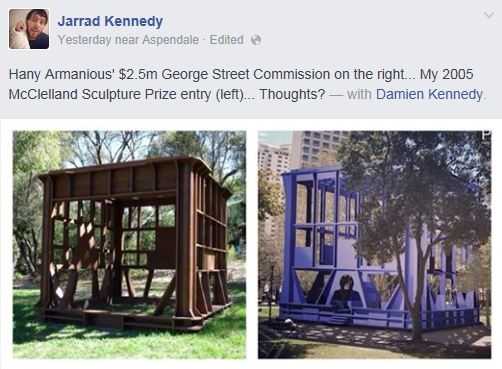
On his Facebook page, the Melbourne artist Jarred Kennedy recently claimed that Hany Armanious' new artwork - a giant milk crate - looks similar to his sculpture, the 2005 McClelland Sculpture Prize entry.

Kennedy's post on his Facebook page

Last Wednesday, three public artworks were revealed by Sydney Lord Mayor, Clover Moore, including Hany Armanious' giant 13.7 metre high milk crate 'Pavilion', which the Sydney council decided to install in Belmore Park, near Central Station.

Armanious, whose giant crate is accused of infringing the copyright in Kennedy's work, is one of Sydney's most respected contemporary sculptors and a globally recognised talent. When Armanious submitted 'Pavilion' for review by Sydney's City Centre Public Art Evaluation Panel, it garnered praise from panel member Lisa Havilah, director of Carriageworks. She said that "Sydney is full of milk crates and there was something wonderfully irreverent about making one 40 times larger that people can enjoy in a park".

Kennedy sent a letter to the City of Sydney and to Amarnious with reference to the alleged copyright infringement. The City of Sydney responded with the statement that a copyright infringement needs some act of copying and Kennedy will have to prove that Armanious had previously seen his milk crate.

While the question of whether Armanious' blue milk crate does infringe upon Kennedy's intellectual property rights remains to be answered, this episode leads to the question of the extent to which the law will protect artistic originality. Adaptation and appropriation of previous works by artists have become increasingly accepted by the artistic community, as we saw already in some posts here and here, for instance, in the Cariou v Prince case.

Where do we draw the line between inspiration and imitation?

Monday, 21 July 2014

Fair Use in the Visual Trenches

I've recently been preparing to teach a class on intellectual property to visual artists in Seattle. As I gathered information and images for a slide show, I wondered how to explain to working artists (in the course of a few hours no less) why this is fair use:


And this is not.


Yes, we can talk about the four main factors in a fair use analysis and, of course, transformativeness and parody, but practically speaking how is a working artist to put this to use? If lawyers and judges can't agree, or even explain the concept without discussing how vague and opaque the fair use doctrine is, what is an artist to do?

During my research I located a January 2014 Fair Use Report prepared for the College Art Association. The report addresses concerns that fair use is underutilized by the visual arts community due to confusion and fear about copyright infringement.

Some of the key findings and figures are summarized in the report as follows:
"Visual artists and other visual arts professionals, a term used in this report to include (among others) art historians, educators, professors, editors or publishers, museum professionals, and gallerists, share a common problem in creating and circulating their work: confusion and misunderstanding of the nature of copyright law and the availability of fair use—the limited right to reuse copyrighted material without permission or payment.

Fair use is flexible, available, and even core to the missions of many visual arts activities. 

Members of the visual arts communities typically overestimate the risk of employing fair use, which leads them to avoid it, even in circumstances where the law permits and so doing would not harm personal relationships necessary for their work.

They pay a high price for copyright confusion and misunderstanding. Their work is constrained and censored, most powerfully by themselves, because of that confusion and the resulting fear and anxiety.”
The report further found that approximately one third of those in the field had abandoned or declined to undertake certain projects due to copyright issues, this includes museums failing to digitize collections, curators declining to do shows where copyright permissions may be an issue, and artists who avoid collage and other types of appropriation art.

While I agree that fair use is flexible and available, it is perhaps the doctrine's over-flexibility that has led to many of these problems. Couple this with copyrights of expansive duration, lack of guidance with respect to orphan works, and at times avid copyright enforcement, and it is no wonder that some artists are avoiding the fair use morass all together. The outcome of these matters is so often unpredictable, and the courts' lack of consistency in application has left us with a hyper-flexible fair use doctrine and vague best practices.

Of course, this is not to say artists should be voluntarily ignorant and fearful of copyright law. Education about copyright serves as an extremely valuable tool in preventing unnecessary self-censorship and allows artists to understand and assess on their own terms the risks associated with particular uses of copyright-protected materials. Indeed artists should have an understanding that they themselves are the beneficiaries (not just the victims) of copyright protection and all the rights and opportunities associated therewith.

Wednesday, 5 March 2014

Artists v Cody Foster

Hot on the heals of the story of M&S allegedly ripping off the designs of an independent artist, comes a similar tale from the US.

An article by Fast Company details the most recent activities of US company Cody Foster & Co. Most recent, because it seems that this is not the first time Cody Foster & Co. has been accused of copying artists' works.

Indeed, as background to the current story, in the last few years Cody Foster has been regularly accused of selling numerous items on its website which are very similar, if not identical, to the works of several different artists and designers.

Many of these small artists, unfortunately, do not have the resources to bring a legal claim against Cody Foster. Therefore, they have tried to bring the company to account by publicising its actions on the internet and via social media. To some extent this has been successful - with some major retailers ceasing their dealings with Cody Foster. This does not appear, however, to have stopped Cody Foster. In fact, rather than produce their own original pieces, Cody Foster is just trying to suppress the claims against them. The Fast Company reports:
"Accused of ripping off the designs of a number of independent designers late last year, [Cody Foster & Co] is now trying to settle one of the lawsuits that has sprung up in the wake of the allegations. 
...The details of the agreement were initially this: While Cody Foster denied having pirated Smith's designs, Cody Foster was still willing to agree to a license to use Smith's deer antler designs, both retroactively and going forward in perpetuity. In exchange for this license, Cody Foster was willing to pay Smith $650 as long as she submitted to a gag order, which would not only prevent her from talking about the dispute in the future, but which would require Smith to delete any mentions of her dispute with Cody Foster from the web, including tweets, Facebook statuses, blog posts, and more. Smith would also have to acknowledge that she had defamed Cody Foster in the eyes of the company's clients."
In other words, Cody Foster is mainly concerned with cleaning up its online reputation. [Although, I'd argue that it can't be that concerned, considering it was only offering $650.] In any case, whether the artist accepted the settlement or not, Cody Foster still has a way to go. From a quick search on Google for 'Cody Foster', apart from the company's own website, the majority of the results contain references to the copying allegations.

The Fast Company article which provides some excellent detail on Cody Foster's activities, as well as comparisons of artists' designs and Cody Foster's offerings, can be found here.

Source: Fast Company, 5 March 2014 & 18 October 2013

Sunday, 2 March 2014

UK artist squares up to M&S over alleged copying

When UK designer, Louise Verity, came across high street giant Marks & Spencer's latest wall art offerings, she was understandably concerned.

One of Verity's works
M&S piece
Verity has produced and sold her works - which consist of various large messages displayed across printed pages (as in the example above) - through her business Bookishly since 2009.

For their SS14 season, M&S began selling framed wall prints which closely imitated her own.

The World Intellectual Property Review reports:
After seeing the M&S products in November last year, Verity asked for legal advice from a lawyer, who wrote to the retailer suggesting that it was in breach of copyright. 
In response, M&S’s legal representatives said they did not believe the retailer was infringing copyright.

Verity told WIPR: “M&S keeps saying that I don’t own and cannot claim rights on the idea and that the style is an established design practice, but I never claimed the concept was my idea.  
“The problem I have is that it’s a very distinct style and I use the same font in everything I do. The M&S product uses the same font and the layout looks like one of mine.”
Any IP lawyers reading this will be very familiar with the idea of copying the idea versus the expression. I would be interested to hear thoughts on whether this would amount to copyright infringement by M&S. At this stage, however, it does not appear that Verity has gone as far as filing a claim against M&S. Indeed, it seems that M&S has removed their piece from their website and it is no longer available. So perhaps the saga is over for now.


Source: World Intellectual Property Review, 24 February 2014

Thursday, 19 December 2013

Short Film HowardCantour.com Without Credit

This week a short film called HowardCantour.com by actor, Shia LeBeouf, was posted on the website Short of the Week.  Not long after its posting, viewers identified the film as a copy of Justin M. Damiano, a comic written and illustrated by Daniel Clowes.  Clowes is a prolific writer and illustrator, and is the mind behind such famous works as Ghost World and Eightball (later adapted into the film Art School Confidential).  While HowardCantour.com originally premiered at Cannes in 2012 and continued to be shown at other film festivals, it was not until the film was exposed to online audiences that the copying was detected, and LeBeouf was questioned as to the movie's concept.

Clowes gave no permission for the creation of the film, and LeBeouf failed to credit Clowes in any way.  LeBeouf responded to the accusations regarding the film via Twitter, and these responses (and admissions) are reposted in Short of the Week's update regarding the film.  Short of the Week removed the film from its website out of respect to Clowes.

While many have labeled LeBeouf's work a theft, and plagiarism, it bears mentioning that the work may so closely resemble the original--having been called a "near direct adaptation"--as to constitute an unauthorized derivative work, thus infringing on Clowes' copyright in Justin M. Damiano.  It remains to be seen whether Clowes will take any legal action.

As Short of the Week points out, while the internet has often served as tool of intellectual property infringement, in the form of illegal music downloads and the like, but in this case, it was online viewers who were responsible for bringing LeBeouf's copying to light and promoting respect for artists' original works.

Tuesday, 26 November 2013

"Girls" Parody or Just Infringement?

Some of our readers may be familiar with this video by San Francisco start up toymaker, GoldieBlox, which recently went viral.  The company develops science and engineering-related toys for girls.  In the video several young girls build a Rube Goldberg machine to turn off a television.  The soundtrack is a version of the Beastie Boys song "Girls," but with new, female-positive lyrics.  The Beastie Boys were not pleased about the use of their song.  When the band attempted to confront GoldieBlox about use of the song, GoldieBlox rapidly filed a lawsuit in U.S. District Court for the Northern District of California seeking declaratory judgment that their use of the Beastie Boys song was parody, and accordingly fair use, not copyright infringement.

In an open letter to GoldieBlox, which the Beastie Boys shared with the New York Times on Monday, the group maintains that they support the work and the message of the start up, but are committed to keeping their music out of advertisements. The band argues that the video was designed to advertise and sell GoldieBlox toys and that using the new version of the song is copyright infringement.

GoldieBlox maintains that their version of the song is not just devised for selling toys, but intended to comment on the original while empowering young girls.  As the complaint states:
In the lyrics of the Beastie Boys’ original song, girls are limited (at best) to household chores, and are presented as useful only to the extent they fulfill the wishes of the male singers. The girls are objects. The GoldieBlox Girls Parody Video takes direct aim at the song both visually and with a revised set of lyrics celebrating the many capabilities of girls. Set to the tune of Girls by the Beastie Boys but with a new recording of the music and new lyrics, girls are heard singing an anthem celebrating their broad set of capabilities—exactly the opposite of the message of the original. GoldieBlox Girls are the subjects; they are the actors taking charge of their environment.
Under U.S. copyright law, fair use of a copyright-protected work is determined by examining the purpose and character of the use, the nature of the copyrighted work, the amount and substantiality of the portion used, and the effect of the use upon the potential market for or value of the copyrighted work.  In the case of parody, the threshold question is whether a parodic character may reasonably be perceived.  In examining parody one must consider the critical bearing on the substance or style of the original.  Undoubtedly, the original version of the song, recorded in 1986, is degrading to women, referencing the desire for "girls" to do the dishes and the laundry.  The song featured in the GoldieBlox video substitutes new lyrics about girls building spaceships, writing code, and engineering that would seem to bear rather directly on the demeaning character of the original.  

The complaint was filed late last week, and attorneys for the Beastie Boys have yet to appear.  As the band has become far more socially and politically conscious over its long existence these would seem particularly difficult public relations to navigate, and it will be interesting to see how this lawsuit unfolds, if at all.


Monday, 25 November 2013

Another Big Win for Photographers: Jury Awards Maximum Damages in AFP v. Morel

Following on the heels of my entry regarding Leonard v. Stemtech, another American photographer has received another major jury award for copyright infringement.  Earlier this year I wrote about AFP v. Morel, a case in which Getty and Associated French Presse (AFP) were found to have used photographer Daniel Morel's photographs of the aftermath of the Haiti earthquakes without permission.  Morel originally shared the photos on Twitter, where another photographer found them and attempted to pass them off as his own.  Eventually the photos ended up in the hands of Getty and AFP, and the agencies used and licensed the images without Morel's permission.  One of AFP's more creative defenses in this case was that Morel's sharing of the images on Twitter had resulted in a broad license allowing AFP to use the images based on Twitter's terms of service.  The court rejected that argument at the summary judgment phase.

Although Morel already prevailed on summary judgment as to direct copyright infringement, because he sought elevated statutory damages for willful infringement, a jury was left to resolve the intent of Getty and AFP in using Morel's images.

On November 22, 2013, the jury's verdict was announced.  Holding that the infringement was willful, the jury awarded Morel the maximum in statutory damages allowed for the eight infringed images, $150,000 per image, for a total damages award of $1.2 million.

Extensive coverage of the trial is available on EPUK.

Wednesday, 23 October 2013

When photographers attack

Seven professional photographers have sued the NFL, as well as Getty Images and the Associated Press, for copyright infringement in a claim filed this week in the US Federal Court.

The Courthouse News Service explains:
The lawsuit involves only photos that the photographers shot "on spec" - meaning on speculation: to be paid per photo, not by the day or hour - and the library of "literally hundred of thousands" of such NFL-related photos. 
The photographers claim they retained copyright in the photos they shot on spec, but the licensing defendants and the NFL ignored that, to reuse their work for ads, news, promotions, products, and to boost the NFL's image and profits. 
"Although plaintiffs license the photos that they shot 'on spec' through third-party licensing agents (formerly NFL Photos and then Getty Images and currently AP), they never transferred their copyrights in these photos to their agents," the lawsuit states. "Rather, as plaintiffs' contributor agreements expressly provided, they retained sole and exclusive ownership of all copyrights in these photos. 
"This action concerns the NFL defendants' rampant, willful, and continued misuse of photographs to which plaintiffs own copyrights. This action also involves Getty Images' and AP's illegal and unethical misconduct which permitted, encouraged, and contributed to the NFL defendants' infringements."
It looks like the licensing arrangements between the various parties are key to the claim. Essentially, it seems that the photographers were, at different times, represented by Getty and AP, who licensed their images to the NFL. However, it is alleged that neither Getty nor AP were working in the photographers' best interests. One complaint being that while Getty and AP licensed the plaintiffs' photos on a "rights managed" basis, in fact they allowed the NFL unlimited access to the photos and did not track their usage. There are also claims that due the photographers also suffered due to the licensing arrangements between the NFL and the other defendants.

The photographers are seeking damages for copyright infringement, as well as damages for vicarious and contributory copyright infringement, breach of contract and breach of fiduciary duty. They also want the NFL to be prevented from further copying, displaying, distributing or selling their images, and to deliver up the infringing photographs.

Source: The Courthouse News Service, 21 October 2013

Thursday, 17 October 2013

The Show Can Go On

A copyright dispute which threatened to postpone the opening of an exhibition of sculptures by artist Lauren Clay has been resolved.

By way of background, the exhibition was to include a number of sculptures by Clay which paid homage to the works of American Abstract Expressionist sculptor and painter, David Smith. Unfortunately, this was not acceptable to the Estate of David Smith. Indeed, BlouinArtInfo reports that:
When the estate became aware that Clay was planning a show including these referential works, it reached out to Clay through its copyright representative, the licensing and rights management organization VAGA. 
“They demanded an accounting of the work,” said Clay, who was openly scornful of what she sees as VAGA’s interference with her artistic freedom. She added that that the organization had asked her to write a letter requesting permission to copy the Smith pieces — “as if I need permission,” she said — and explaining why she was making the work. “Basically they were bullying everyone and intimidating everyone,” she said, to prevent her pieces from being shown. 
In response, Clay's lawyer wrote to VAGA arguing that Clay's works were in not an infringement of Smith's works, rather they fell within the fair use provisions of US copyright law as transformative works.

Now it seems, however, that the question as to whether or not the works do infringe copyright is merely academic as the parties have come to an agreement in accordance with which Clay will not to sell the works and/or to display them with a statement acknowledging that the works are not authorised by David Smith's estate.

Academic or not, what do our readers think?

Clay

v

Smith

Source:  BlouinArtInfo, 3 October, 2013, Art in America, 15 October, 2013

Wednesday, 21 August 2013

Exploring "Orderly Form" Requirements for U.S. Copyright Registrations


Again underscoring the importance of not just obtaining copyright registrations, but doing so correctly, the U.S. Court of Appeals for the Seventh Circuit recently explored the "orderly form" requirement for copyright registrations covering collections of works.

The plaintiff, sculptor Quincy Neri, sued the defendants for copyright infringement after they posted photographs online that included her sculpture.  The parties engaged in a joint project remodeling a home by installing a vaulted ceiling and Neri's glass sculpture.  The architecture company, a named defendant in the case, took photographs documenting the progress of the space, and two of these photos included Neri's sculpture.  The photos were shared online by the company as well as the home owner.  Based on these facts, Neri then sued the architectural company, the home owner, and others for copyright infringement.

Under U.S. copyright law, a copyright arises when an original work of authorship becomes fixed in a tangible medium, however litigation to enforce a copyright requires that the plaintiff have obtained a copyright registration.  In this case, Neri asserted that she had a copyright registration for the sculpture at issue, but the registration covered multiple works in a collection.  The district court found the copyright invalid on this basis and dismissed the case.  On appeal, the Seventh Circuit held otherwise.

To obtain her copyright registration, Neri submitted a booklet of works as well as a selection of numbered photographs to the U.S. Copyright Office claiming that the works were part of a single collection called "Artwork of Q."  Defendants attacked the validity of the copyright registration and alternatively alleged that the registration did not in fact cover the sculpture that appeared in the remodel photographs.  Relying upon the administrative rules governing copyright registration of a collection, the Seventh Circuit held that the case been wrongly dismissed since the lower court judge had not actually evaluated the materials submitted to the copyright office, and instead had only reviewed deposition testimony of their nature.  Neither party had placed the deposit materials for the copyright registration on the record.  Neri thus benefited from the registration's entitlement to the presumption of validity.  The court, left grappling with the "orderly form" requirement for materials submitted for copyright registration of a collection concluded, "the key question must be whether the submission is organized well enough to permit users and courts to pin down the 'information' on which copyright enforcement depends."  And further, "Any organization that enables a court to associate a work underlying the suit with a work covered by a registration ought to do the trick."  

Ultimately, the case was remanded with instructions for the district court to reconsider its conclusions on the validity of the copyright registration and further to consider other previously overlooked issues such as joint authorship of the sculpture because the home owner and architectural company may have made creative contributions in determining the color and arrangement of the sixty glass pieces that comprised the finished sculpture.  The court further opined that sharing the pictures online may constitute fair use.

The court's full opinion may be accessed here.

Monday, 12 August 2013

Russia's IPC to Hear Lady in Blue Appeal


Russia’s specialized Intellectual Property Court (IPC), which just became operational in July 2013, will be hearing an appeal regarding the appearance of a famous painting in fashion designs.

Iya Yots, a fashion designer from St. Petersburg, was sued by The State Hermitage Museum over use of an image of Thomas Gainsborough’s painting, “Portrait of a Lady in Blue” in her works.

The IPC may hear cases as both a court of first instance, or as a supreme court of appeals. Yots appeals this case after the Sixteenth Commercial Court of Appeals affirmed an unfavorable decision by the Commercial Court of the Stavropol Territory prohibiting her from using the image without the Museum’s permission.