Showing posts with label looted art. Show all posts

Friday, 29 May 2015

US returns looted art to Italy

This week saw the return by the United States of 26 pieces of art to Italy. Each work had been separately looted and subsequently smuggled out of Italy and into the US.

A Repatriation Ceremony was held at the US Embassy in Rome to celebrate the return of the pieces to Italy. The ceremony was a culmination of a lengthy investigation carried out collaboratively between the US Homeland Security Investigations (HSI) and the Carabinieri Tutela Patrimonio Culturale (TPC).

In his speech at the Ceremony, US Ambassador to Italy, John R. Phillips, noted that:
"Italy is blessed with a rich cultural legacy and therefore cursed to suffer the pillaging of important cultural artifacts. The collaboration between agents from HSI and investigators from the TPC has borne fruit in returning some important artifacts to their rightful home in Italy. 
The plundering of historical and cultural artifacts is among the oldest forms of cross-border organized crime. INTERPOL estimates that the illicit trading in cultural property produces more than $9 billion in profits each year – only human trafficking, narcotics and weapons trades generate more illicit revenue. 
The crime may be ancient, but the perpetrators are very modern. The use of the Internet has provided these criminals the ability to acquire, transport, advertise and sell valuable cultural property swiftly, easily and stealthily and while making it easier to evade detection by law enforcement agencies. 
Fortunately, the customs laws of the United States allows agencies such as HSI and CBP the ability to seize, forfeit and ultimately return cultural property that is brought into the United States illegally." 
Some of the artworks that were returned include:

Sleeping Beauty, a 1,800 year-old, ancient Roman marble sarcophagus lid of sleeping Ariadne, which investigation revealed was smuggled out of Italy. HSI New York special agents seized the sarcophagus lid with a warrant issued from the Eastern District of New York.

A 5th century B.C. Etruscan black figured Kalpis, which is believed to have been looted in Italy and smuggled into the United States in 1981. After an investigation, our HSI office in Cleveland, Ohio, seized the Kalpis.


A 5th century B.C. red-figured Attic Volute Krater attributed to the Methyse Painter. This Kalpis was seized by HSI St. Paul, Minnesota.


A 17th century Venetian bronze breech-loading gun, which was seized by CBP officers in Boston as it was being smuggled into the United States. After an HSI Boston investigation, the cannon was successfully forfeited.


Reportedly, no criminal charges have been filed in relation to any of returned artworks since, in some cases, the statute of limitations on any crimes would have expired, and, in others, the paper trail for the piece's import into the US was too difficult to reconstruct. In addition, these pieces represent but a fraction of the art currently circulating on the black market. Nonetheless, as Phillips stated "every victory, every piece that is returned, every bit of cultural history that can be restored to its rightful home is a measure of progress."

Source: The New York Times, 26 May 2015

Monday, 26 January 2015

Supreme Court rejects Norton Simon's appeal in looted art case

On 20 January, the US Supreme Court declined to hear the Norton Simon Museum's appeal in a case contesting its ownership of diptych "Adam" and "Eve" by Lucas Cranach the Elder. The Supreme Court's rejection allows Marei Von Saher to pursue her lawsuit to reclaim the Cranach paintings. 

Von Saher alleges that the diptych was looted from her father-in-law, Jacques Goudstikker, during the Nazi era. More specifically, that the Nazis conducted forced sales of Goudstikker's artworks, including the diptych, which Goudstikker left behind when he fled the Netherlands in 1940 (see our previous post for more details)

The museum had argued – both in the California appeal court and in its application to the Supreme Court – that Von Saher's claims conflicted with the US policy on resolving war-related art disputes, and with its right to conduct foreign affairs. The US District Court agreed. 

Last June, however, the 9th Circuit Court of Appeals overturned the District Court's ruling, stating that allowing Von Saher's claim to proceed "would encourage the Museum...to follow the Washington principles [which call for restitution]...Perhaps most importantly, this litigation may provide Von Saher an opportunity to achieve a just and fair outcome to rectify the consequences of the forced transaction with Goering during the war". 

The immediate consequence of the Supreme Court's decision is that the case, which has focused solely on preliminary legal issues since it was filed in 2007, will resume with additional preliminary proceedings before a federal judge in Los Angeles. Nevertheless, the outcome of this lawsuit remains uncertain. Indeed, LA District Court judge John Walter has already twice dismissed the case, only to have his rulings appealed and overturned by the 9th Circuit. 

Regardless how the battle over "Adam" and "Eve" turns out, however, the consequence of the Supreme's Court non-action is that the legal theory behind the 9th Circuit's ruling becomes binding precedent in federal courts in nine Western states. 

The 9th Circuit held that US courts should accept the 1998 Washington Principles and the 2007 Terezin Declaration as statements of US foreign policy. These two documents provide that signing members should no longer put legal obstacles to legitimate claims for the return of Nazi-looted art. Art law experts, therefore, foresee that a possible consequence of the Supreme Court's decision is that these two document have legal effect in US Courts. 

The 9th Circuit also said that the US District Court should turn its attention whether the Act of State Doctrine applies to the paintings. This Doctrine states that US courts cannot hear cases involving government policies and the official actions of foreign governments. If the Doctrine does apply, the Judge will have to evaluate whether the Dutch government's handling of "Adam" and "Eve", in particular whether their 1996 sale of the diptych, qualifies as a policy action by the Dutch government.


Wednesday, 26 November 2014

Swiss museum decides to accept Gurlitt's collection

The trustees of the Kunstmuseum Bern announced yesterday that the museum has decided to accept the bequest of Cornelius Gurlitt's art collection.

We have already spoken herehere and here about Gurlitt's art collection, which was discovered in a Munich apartment in 2012 during a routine tax investigation. The majority of the collection is believed to have been amassed by Gurlitt's father, the Nazi-era art dealer Hildebrand Gurlitt, who told US authorities after World War II that his collection had been destroyed by Allied bombing.  

After Gurlitt's death last May, the Swiss museum took the full six months allowed by German probate law to decide whether to accept or reject the gift.  At a joint press conference, the chairman of the museum's board of trustees announced that works that are believed to have been looted will stay in Germany, while a team of researchers investigate their provenance. In this regard, the Kunstmuseum announced today that it has set up a provenance department.

The decision to accept Gurlitt's bequest is likely to open the Kunstmuseum up to years of litigation, as the President of the Jewish World Congress, Ronald Lauder, has already warned.

In addition, the Kunstmuseum's decision to accept the bequest comes just a few days after Gurlitt's cousin, Uta Werner, announced that she has submitted a certificate of inheritance to the Munich probate court, challenging the testamentary capacity of Cornelius Gurlitt to bequeath his collection to the Kunstmuseum. If this were the case, Gurlitt's cousin and other heirs would inherit the whole art collection. Gurlitt's heirs have already said that – unlike the Kunstmuseum – they will return each artwork to their rightful owner.

We shall have to wait and see who will eventually manage Gurlitt's collection.

Tuesday, 28 October 2014

A tale of two Schieles

We have quite regularly discussed different cases of art stolen from Jewish families by the Germans during World War II on this blog. The one point they all have in common is that it is always difficult to predict the outcome. There is never a straightforward answer to whether the art will be returned.

A recent case illustrates the incongruent approaches to the cases. 

Two paintings by Austrian artist Egon Schiele are being auctioned next month. One by Christie’s and one by Sotheby’s.

Schiele's "Seated Woman with Bent Left Leg"
Schiele's "Town on the Blue River"

The result of the sales will, however, be very different for the family of Fritz Grünbaum, who once owned both pieces.

As reported by The New York Times:
Christie’s is selling Schiele’s 1910 watercolor “Town on the Blue River,” on Nov. 5 in conjunction with a restitution agreement that treats the work as looted art and provides compensation to Grünbaum’s heirs. 
Sotheby’s is selling a 1917 gouache and crayon work, “Seated Woman With Bent Left Leg,” on Nov. 4 under an arrangement that will not compensate the family. The auction house is relying on rulings by United States federal courts that found the family waited too long to file its claim and that there was insufficient evidence to conclude “Seated Woman” had been stolen.
The different approaches apparently stems from the fact that it all comes down to the word of a Swiss art dealer who says he bought dozens of Schieles from Grünbaum’s sister-in-law.

Grünbaum had accumulated a substantial art collection prior to 1938 when he was sent to Dachau and all his art was seized. His collection included 81 Schieles, however, it is not clear whether these two paintings were part of it.

After the collection was seized, it was moved to a storage depot in Vienna. Grünbaum died in 1941, and his wife, Elisabeth, died in 1942, in a concentration camp.
 The New York Times continues:
The next time any of the works from Grünbaum’s collection surfaced on the art market was in the 1950s, when the Swiss dealer, Eberhard Kornfeld, sold some. Mr. Kornfeld later said he had purchased them from Elisabeth Grünbaum’s sister, Mathilde Lukacs-Herzl, who died in 1979. Mr. Kornfeld produced correspondence with Ms. Lukacs-Herzl, tax stamps and other documentation to support his account. 
Jonathan Petropoulos, the former art research director for the Presidential Advisory Commission on Holocaust Assets in the United States, has called Mr. Kornfeld’s story suspicious, in part because the documents carry varied spellings of the name “Mathilde” in penciled signatures and because he did not identify her as the source of the works until decades after her death. In any case, Mr. Petropoulos, who was hired by the Grünbaum family legal team, argues that Ms. Lukacs-Herzl did not have title to the art because she was never declared Grünbaum’s heir by an Austrian court, as required.  
So, on the one side Sotheby’s is taking Kornfeld's word that he acquired the paintings lawfully. On the other, Christies's acknowledge that the position is complicated and therefore will treat the painting as looted art and compensate Grünbaum’s heirs.

While the lack of consistency is not surprising, it is nevertheless disappointing particularly since it is very likely that the paintings came from the same collection. And while there are several organisations that are still working to right wrongs that took place over 70 years ago, as those events become ever more distant it becomes even more likely that the disparities will only increase.


Source: The New York Times, 24 October 2014

Friday, 27 June 2014

Ownership of Nazi-looted art at Pasadena Norton Simon Museum disputed

Another post on Art & Artifice on looted art.

This case concerns two sixteenth-century oil paintings looted in 1940 from the collection of a noted Dutch art collector and dealer, Jacques Goudstikker. The two paintings "Adam" and "Eve" by Lucas Cranach the Elder were acquired by the Norton Simon Museum of Art in Pasadena, California in 1971 and, to date, have regularly been on display.

In May of 2007, Marei von Saher, Jacques Goudstikker's sole heir, filed a complaint in the Federal Court for the Central District of California seeking to recover the paintings.

The history of the two paintings is complicated by multiple lootings and suspicious changes-of-hand.

Before the 20th century, the diptych was in a Kiev Church for more than 400 years, until the Soviets moved the works to the Art museum of the Ukranian Academy of Science. Then, the Soviet government decided to auction the works in Berlin where the Jewish art dealer, Jacques Goudstikker, bought them in 1931.

During World War II, in 1940, Mr Goudstikker fled the Netherlands when Germany invaded and died while crossing the Atlantic to South America. Several hundreds of works in his gallery, including the two Cranach paintings, were later sold in two circumstances: to the German bank Alois Miedl during an auction, and to the Nazi Reichsmarschall Hermann Göring at a fraction of their value.

At the end of the World War II, the works were eventually restituted to the Dutch government in 1946 by the Monuments Men.

Goudstikker’s widow filed timely claims with the Dutch government and reached a settlement in 1952. Under that settlement, she received most of the property taken by Alois Miedl, but the agreement did not cover the artworks taken by Göring.

The paintings were then the subject of a claim concerning Goudstikker’s initial acquisition from the Soviet Union. A Mr George Stroganoff-Scherbatoff successfully petitioned the Dutch government to return the paintings to him on the grounds that the Soviet Union had illegally taken the works from his Russian family before Goudstikked bought them. So, in 1966, the Dutch government quietly gifted the work back to George Stroganoff-Scherbatoff, denying the restitution claims by Goudstikker’s wife. Then, in 1971, the Norton Simon museum acquired the panels from George Stroganoff-Scherbatoff.

Finally, three decades later, Von Saher learned of the paintings whereabouts, and sued the Norton Simon Museum in 2007, after six years of talks failed to resolve the case.

In March 2012, US District Judge John Walter dismissed the case, finding that Von Saher's claims conflicted with US policy on recovered art.

However, on June 6, the 9th US Circuit Court of Appeals reversed the 2012 decision, returning the case to the District Court. 

Now we will have to wait and see whether the transfer to Stroganoff-Scherbatoff will be considered as a Dutch "act of state" that a US court should not disturb or not.

Tuesday, 24 June 2014

Israel and Germany agree to cooperate on looted art

This blog has often covered cases and disputes over art stolen from Jews during World War II.

The most recent news on this topic appears to be rather positive. Last week Israel and Germany signed an agreement under which joint-research will be conducted in museums in both countries to determine the provenance of art suspected to be Jewish-owned art looted during World War II.

The AFP reports that under the agreement, which was signed by the countries' respective Culture Ministers, art experts from Israel and Germany will undergo training and coordinate the formation of joint databases.

The agreement apparently formalises the ongoing cooperation between the two countries, which was particularly tested recently with the discovery of the "Gurlitt stash" (reported here, here and here).

German Culture Minister Monika Gruetters released a statement about the agreement, which says that the agreement represents a "huge vote of confidence" as Germany does not work with any other country in this way. The statement also provides further details as to how the agreement and cooperation between the countries is intended to work in practice. [Unfortunately it is in German, and that's about as far as my German goes. Curious German speakers can read the rest here.]

It will be interesting to see if there is any change to looted art cases going forward, in the wake of this agreement.

Friday, 23 May 2014

Cambodia to Cleveland?

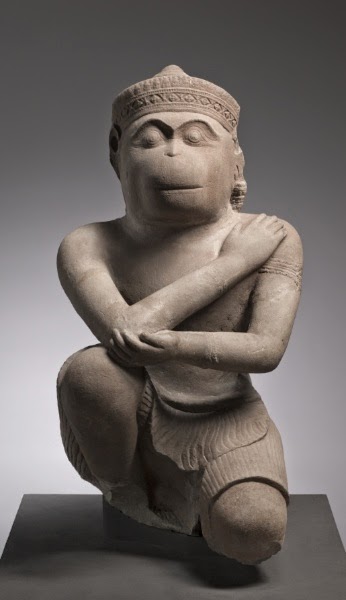
Last year saw several claims by Cambodian officials in respect of art they allege was looted from Cambodia during the Khmer Rouge regime. One of the claims was to a statue in the Cleveland Museum of Art collection, which the Cambodian cultural authorities say was looted from Prasat Chen, a 1000-year-old temple about 75 miles northeast of the better known Angkor Wat.


This month, the Cleveland Museum announced that after lengthy investigations they have determined that the statue is not from from Prasat Chen.

The Plain Dealer reports:
During the winter, the museum sent curator Sonya Rhie Quintanilla to Prasat Chen, a site of temple ruins 180 miles northwest of Phnom Penh.  
Based on her research, the museum said it has ruled out Prasat Chen as the sculpture's original location, although it said it could not rule out the possibility that it may been removed illegally from some other site.  
To check whether the work came from Prasat Chen, Quintanilla, the museum's curator of Indian and Southeast Asian art, carried in her luggage a lightweight plastic resin facsimile of the base of the Cleveland sculpture.  
When she reached the site, where a thousand-year-old temple features sculptures that narrate Hindu legends, she said she found that the facsimile did not fit the two spots where the museum's Hanuman sculpture logically might have been located.
While perhaps some kudos to the museum for doing some homework, is it really sufficient to say that the statue was not looted because it doesn't fit onto a particular base? I would have expected the museum to concentrate on proving the statue's provenance by reference to its ownership history. Who sold it to the museum? What background checks were performed? etc.

And, granted, the museum is said to be looking into this too. Nevertheless, it seems a bit premature to say the statue is not from Cambodia based on....essentially...a base.


Source: The New York Times, 20 May 2013, The Plain Dealer, 13 May 2014

Thursday, 22 May 2014

Dutch collections include art looted during World War II

It has been reported that the art collections of the Palace Het Loo, the Rijksmuseum and three other museums are thought to include pieces and artifacts that were looted from a Jewish family during World War II.

The NL Times explains that:
In total, 15 pieces of a valuable Meissen porcelain dinnerware ware set may have been stolen from the Gutmann family. The items may have been put up for auction in 1934 under coercion from the Nazis.

Now, 80 years after the fact, Amsterdam investigation bureau Artiaz was able to trace the pieces, to the museums...
Artiaz traced the dinnerware set pieces by looking through old auction documents... 
The items are part of a unique 435-piece Meissen dinnerware set depicting village scenes, which was given to Willem V around 1774 as a gift from the United East-Indian Company. The prince sold the set during exile in England.
Artiaz also said that it was controversial that the Ekkart Committee, which was appointed on 1 April 1999 to supervise the provenance research carried out on works of art confiscated during World War II and repatriated to Holland from Germany after the war (the "NK Collection"), failed to identify that the pieces had been looted. However, with the continual stream of new claims over artworks which were stolen from Jewish families during World War II, perhaps this is the least surprising aspect of the story.

Source: NL Times, 14 May 2014.

Wednesday, 12 February 2014

More artworks discovered in Austria

Back in November 2014, the discovery of a trove of hundreds of art masterpieces in an apartment in Munich made headlines around the world.

As we explained here, the trove was found by German authorities investigating Cornelius Gurlitt, the 81 year old son of Nazi-era art dealer Hildebrand Gurlitt. Upon entering Gurlitt's apartment, the authorities discovered the artworks, including some believed to have been looted by the Nazis.

It is now being reported that yet more pieces were discovered in a second home belonging to Gurlitt.

The Telegraph reports:
Officials investigating the secret Nazi-era art cache hoarded by an elderly German art collector are examining a second stash of paintings found at another of his addresses. 
Cornelius Gurlitt, who kept around 1,400 works at his apartment in Munich, also had around 60 pieces in a flat in the Austrian city of Salzburg, it was disclosed. 
...
The works were secured on Monday and were being examined by experts at Mr Gurlitt’s request to establish whether any of them had been looted by the Nazis, said [Mr Gurlitt’s spokesman, Stephan Holzinger].

“At the request of Cornelius Gurlitt, the works are being examined by experts on whether they include possibly stolen art,” he said. “A preliminary assessment based on an initial screening did not substantiate such a suspicion.”

Source: The Telegraph, 11 February 2014.

Monday, 10 February 2014

Nazi looted painting returned

Another painting which was seized by the Nazis during World War II [an unfortunately very familiar scenario] has been returned to Poland [a not-so-usual result].


After almost 6 years of investigations, the US Immigration Customs and Enforcement's Homeland Security Investigations (HSI) announced the return of "Saint Philip Baptizing a Servant of Queen Kandaki" by German artist Johann Conrad Seekatz on 6 February 2014. On the same day, a ceremony was held to officially hand the paining back to Poland.

HSI's press release detailed their investigations:
In June 2008, HSI New York special agents were notified by the Consulate General of the Republic of Poland that several national treasures of their cultural heritage looted during World War II were being offered for sale in the United States. 
HSI New York agents met with Polish officials who provided supporting documentation to assist in the identification and recovery of the looted Polish work of art. HSI agents initiated an investigation and identified that the painting came into the possession of Doyle New York Auctioneers and Appraisers in about October 2006 and was sold under its erroneous name for approximately $24,000 to Rafael Valls Gallery in London. 
An expert from the National Museum in Warsaw, delegated by the Polish Ministry of Culture and National Heritage, examined the painting in London with the full cooperation of the Rafael Valls Gallery and it was determined to be the same painting that was looted from Warsaw in 1944. In April 2012, HSI received an evaluation of the painting from the Ministry that the painting was identified as its true name and artist... 
On July 12, 2012, after learning the painting was stolen, it was seized by HSI agents from the London gallery by stipulation order with the assistance of the US Attorney’s Office for the Southern District of New York (SDNY). The painting was returned to New York from London leading to the Feb. 6 repatriation to the Republic of Poland.br />
Three other looted artworks were previously returned to Poland in 2010 and 2011. It remains to be seen if there will be others.

The Polish Ministry of Culture and National Heritage runs an on-line database which details the country's wartime losses. There are thousands of artworks which are still missing.

Read the full HSI press release here

Monday, 4 November 2013

A Nazi-looted art trove of 1,500 masterpieces was discovered in Munich

A treasure trove worth around 1 million dollars has been recently found in an apartment in Munich.

The trove includes masterpieces of Picasso, Henri Matisse, Auguste Renoir and Marc Chagall. Other works among the 1,500 discovered were by Otto Dix, Franc Marc, Emil Nolde, Oskar Kokoshka and Ernst Ludwig Kirchner.

The trove was found by German tax authorities while they were investigating on the possible tax evasion of Cornelius Gurlitt, the son of the art dealer Hildebrandt Gurlitt. The tax authorities went into Gurlitt's apartment, where they expected to find few undeclared euros, but they discovered piles and piles of old food in every room of the house and behind these walls of food the trove was incredibly hidden.

Hildebrant Gurlitt was a well-known art historian during the Nazi era, who was tasked by the SS official Goebbels to sell the so-called “degenerate” artworks seized by the Hitler's government. Nazi regime seized around 20,000 works before the Second World War and many of them were shown during the "Degenerate Art" exhibition, which took place in Munich in 1937.

Indeed, many masterpieces were found "ungerman" by the Nazi regime: Hitler loved only classical art. Therefore, these masterpieces were seized, stolen from collectors - many of them Jewish. Jewish collectors were also forced to sell “degenerate” works of art at a very low price to art dealers, in order to purchase expensive visas to flee from Germany.

The recovered works are currently stocked by the Bavarian customs in Garching near Munich and a team of art experts is trying to find the rightful owners' heirs. One painting is said to be a Matisse's portrait of a woman previously belonging to the famous jewish collector Paul Rosenberg.

Source: The Guardian, 3 November 2013