"An artist has won almost $1.35 million in a lawsuit over a sculpture commemorating workers who were paid $5 per day to risk their lives during the construction of Hoover Dam. A jury in Las Vegas federal court ruled last month in favor of artist Steven Liguori, creator of the bronze statue known as the “High Scaler” at Hoover Dam.Damages for breach of contract and copyright infringement are nothing new and, by the standards of litigation in the United States today -- especially when compared with the massive damages awarded by juries for patent infringement in the same jurisdiction -- $1,3 million seems almost trivial. However, the juxtaposition of that sum against "$ 5 an hour" makes it sound unfairly large. There is also the implication that it's somehow unfair for an artist to gain more financially from his art than is paid to laborers who risk life and limb while dangling from ropes, though the truth of the matter is that the supply of monumental sculptors is far more limited than the availability of high scalers, a factor that is inevitably going to be reflected in the contract terms offered to Liguori in the first place.
In 2011, Liguori sued Bert Hansen, longtime owner and operator of the Hoover Dam Snacketeria and the High Scaler Cafe at the dam, after the artist said he was cheated out of royalty payments and his work was used without permission for merchandise and marketing. According to the lawsuit, Hansen commissioned Liguori to create “High Scaler” for a $166,000 fee and a share of the proceeds from merchandise based on the sculpture as well as the artist’s other dam-related creations.
U.S. District Judge George Foley ordered Hansen to pay Liguori $1.2 million for breaching their agreement and $150,000 in other damages.
The sculpture at the center of the legal dispute is modeled on a photograph of a high scaler, a special breed of Hoover Dam laborer willing to clear loose rock from the walls of Black Canyon while dangling from ropes tied to clifftop eye bolts.
“They were the celebrity laborers on the dam,” said Dennis McBride, director of the Nevada State Museum at the Springs Preserve and a leading Hoover Dam historian. “They’d be sitting in their bosun’s chairs, and over the side they went.”
... The Las Vegas law firm Hutchison &Steffen, which represented Liguori, announced the final judgment in the lawsuit Thursday. “A jury of his peers found that he just wasn’t treated fairly,” Hutchison &Steffen partner Todd Moody said of Liguori in a written statement. “Not only did they breach the contract they had with him, they also infringed on the copyright he had. And to be awarded the highest statutory amount was kind of the icing on the cake.” ...".
Showing posts with label United States. Show all posts
Showing posts with label United States. Show all posts
Friday, 5 June 2015
Dammed if you do, damned if you don't: are sculptors worth more than scalers?
"Hoover Dam artist wins $1.3 million in copyright lawsuit" is the striking headline of an article by Henry Brean in the Las Vegas Review Journal, here. According to the author:


Friday, 29 May 2015
US returns looted art to Italy
This week saw the return by the United States of 26 pieces of art to Italy. Each work had been separately looted and subsequently smuggled out of Italy and into the US.
A Repatriation Ceremony was held at the US Embassy in Rome to celebrate the return of the pieces to Italy. The ceremony was a culmination of a lengthy investigation carried out collaboratively between the US Homeland Security Investigations (HSI) and the Carabinieri Tutela Patrimonio Culturale (TPC).
In his speech at the Ceremony, US Ambassador to Italy, John R. Phillips, noted that:
Sleeping Beauty, a 1,800 year-old, ancient Roman marble sarcophagus lid of sleeping Ariadne, which investigation revealed was smuggled out of Italy. HSI New York special agents seized the sarcophagus lid with a warrant issued from the Eastern District of New York.

A 5th century B.C. Etruscan black figured Kalpis, which is believed to have been looted in Italy and smuggled into the United States in 1981. After an investigation, our HSI office in Cleveland, Ohio, seized the Kalpis.

A 5th century B.C. red-figured Attic Volute Krater attributed to the Methyse Painter. This Kalpis was seized by HSI St. Paul, Minnesota.

A 17th century Venetian bronze breech-loading gun, which was seized by CBP officers in Boston as it was being smuggled into the United States. After an HSI Boston investigation, the cannon was successfully forfeited.

Reportedly, no criminal charges have been filed in relation to any of returned artworks since, in some cases, the statute of limitations on any crimes would have expired, and, in others, the paper trail for the piece's import into the US was too difficult to reconstruct. In addition, these pieces represent but a fraction of the art currently circulating on the black market. Nonetheless, as Phillips stated "every victory, every piece that is returned, every bit of cultural history that can be restored to its rightful home is a measure of progress."
Source: The New York Times, 26 May 2015
A Repatriation Ceremony was held at the US Embassy in Rome to celebrate the return of the pieces to Italy. The ceremony was a culmination of a lengthy investigation carried out collaboratively between the US Homeland Security Investigations (HSI) and the Carabinieri Tutela Patrimonio Culturale (TPC).
In his speech at the Ceremony, US Ambassador to Italy, John R. Phillips, noted that:
"Italy is blessed with a rich cultural legacy and therefore cursed to suffer the pillaging of important cultural artifacts. The collaboration between agents from HSI and investigators from the TPC has borne fruit in returning some important artifacts to their rightful home in Italy.
The plundering of historical and cultural artifacts is among the oldest forms of cross-border organized crime. INTERPOL estimates that the illicit trading in cultural property produces more than $9 billion in profits each year – only human trafficking, narcotics and weapons trades generate more illicit revenue.
The crime may be ancient, but the perpetrators are very modern. The use of the Internet has provided these criminals the ability to acquire, transport, advertise and sell valuable cultural property swiftly, easily and stealthily and while making it easier to evade detection by law enforcement agencies.
Fortunately, the customs laws of the United States allows agencies such as HSI and CBP the ability to seize, forfeit and ultimately return cultural property that is brought into the United States illegally."Some of the artworks that were returned include:
Sleeping Beauty, a 1,800 year-old, ancient Roman marble sarcophagus lid of sleeping Ariadne, which investigation revealed was smuggled out of Italy. HSI New York special agents seized the sarcophagus lid with a warrant issued from the Eastern District of New York.

A 5th century B.C. Etruscan black figured Kalpis, which is believed to have been looted in Italy and smuggled into the United States in 1981. After an investigation, our HSI office in Cleveland, Ohio, seized the Kalpis.

A 5th century B.C. red-figured Attic Volute Krater attributed to the Methyse Painter. This Kalpis was seized by HSI St. Paul, Minnesota.

A 17th century Venetian bronze breech-loading gun, which was seized by CBP officers in Boston as it was being smuggled into the United States. After an HSI Boston investigation, the cannon was successfully forfeited.

Reportedly, no criminal charges have been filed in relation to any of returned artworks since, in some cases, the statute of limitations on any crimes would have expired, and, in others, the paper trail for the piece's import into the US was too difficult to reconstruct. In addition, these pieces represent but a fraction of the art currently circulating on the black market. Nonetheless, as Phillips stated "every victory, every piece that is returned, every bit of cultural history that can be restored to its rightful home is a measure of progress."
Source: The New York Times, 26 May 2015
Thursday, 19 February 2015
Code of Best Practices in Fair Use for the Visual Arts
I have just received the following message and, since it seems so relevant to this blog, I thought I'd spread the word.

The College Art Association (CAA) has published the Code of Best Practices in Fair Use for the Visual Arts, a set of principles addressing best practices in the fair use of copyrighted materials based on a consensus of opinion developed through discussions with visual-arts professionals. It will be a vital resource for everyone working in the field, including artists, art historians, museum professionals, and editors. Initiated by CAA in 2012, the multi-year effort has been led by the Code’s authors, Peter Jaszi and Patricia Aufderheide, professors of law and communication studies respectively at American University and the leading experts on the development of codes for communities that make use of copyrighted materials in their professional practices.
Linda Downs, CAA executive director, said, “The Code is a crucial contribution to the field as a clear statement on best practices in the fair use of copyrighted materials that directly reflects a consensus from the visual-arts community. CAA is grateful to all of the artists, art historians, museum professionals, and editors, among others, who participated in the project so generously with their time and collective knowledge.”
The Code describes the relevance of fair use in five broad areas of the visual arts field:The document itself is 22 pages in length (inclusive of covers, credits etc), clearly written and with a couple of well worth while appendices on fair use today and the methodology employed in creating the Code in the first place. There's nothing on the face of it, though, that indicates that it is a Code addressed specifically to the United States. Words like "international", "Europe" and "foreign" could not be found on a word search of the Code's text. There's nothing wrong with the Code being US-based, of course, but this blogger has met, over the years, too many creative souls who assume that what is permitted -- or prohibited -- in one country is permitted or prohibited in all, and he would like Codes such as this to make it very plain for non-lawyers as to where their provisions are likely to be most helpful.
- Analytic Writing: When may scholars and other writers about art invoke fair use to quote, excerpt, or reproduce copyrighted works?
- Teaching about Art: When may teachers invoke fair use in using copyrighted works to support formal instruction in a range of settings, including online and distance teaching?
- Making Art: Under what circumstances may artists exercise fair use to incorporate copyrighted material into new artworks in any medium?
- Museum Uses: When may museums and their staffs invoke fair use in using copyrighted works—such as images, text, and time-based and born-digital material—when organizing exhibitions, developing educational materials (within the museum and online), publishing catalogues, and other related activities?
- Online Access to Archival and Special Collections: When may such institutions and their staffs claim fair use to create digital preservation copies and/or enable digital access to copyrighted materials in their collections?
Monday, 26 January 2015
Supreme Court rejects Norton Simon's appeal in looted art case
On 20 January, the US Supreme Court declined to hear the Norton Simon Museum's appeal in a
case contesting its ownership of diptych "Adam" and "Eve" by Lucas Cranach the Elder. The Supreme Court's rejection allows Marei Von Saher to pursue her lawsuit to reclaim the Cranach paintings.
Von Saher alleges
that the diptych was looted from her father-in-law, Jacques Goudstikker, during
the Nazi era. More specifically, that the Nazis conducted forced sales of
Goudstikker's artworks, including the diptych, which Goudstikker left behind when he fled the
Netherlands in 1940 (see our previous post for more details).
The museum had
argued – both in the California appeal court and in its application to the Supreme
Court – that Von Saher's claims conflicted with the US policy
on resolving war-related art disputes, and with its right to conduct foreign
affairs. The US District Court agreed.
Last June, however, the 9th Circuit Court of Appeals overturned the District Court's ruling, stating that allowing Von Saher's claim to proceed "would encourage the Museum...to
follow the Washington principles [which call for restitution]...Perhaps most
importantly, this litigation may provide Von Saher an opportunity to achieve a
just and fair outcome to rectify the consequences of the forced transaction
with Goering during the war".
The immediate
consequence of the Supreme Court's decision is that the case, which has focused solely on preliminary legal
issues since it was filed in 2007, will resume with additional preliminary
proceedings before a federal judge in Los
Angeles. Nevertheless, the outcome of this lawsuit remains uncertain. Indeed, LA District Court judge John Walter has already twice
dismissed the case, only to have his rulings appealed and overturned by the 9th
Circuit.
Regardless how the battle over "Adam" and "Eve" turns
out, however, the consequence of the Supreme's Court non-action is that the legal theory behind the 9th
Circuit's ruling becomes binding precedent in federal courts in nine Western
states.
The 9th Circuit
held that US courts should accept the 1998 Washington Principles and the
2007 Terezin Declaration as statements of US foreign policy. These two
documents provide that signing members should no longer put legal obstacles
to legitimate claims for the return of Nazi-looted art. Art law experts, therefore, foresee that a possible consequence of the Supreme Court's decision is that these two document have legal effect in US Courts.
The 9th
Circuit also said that the US District Court should turn its attention whether the
Act of State Doctrine applies to the paintings. This Doctrine states that US courts cannot hear cases involving government policies and the official
actions of foreign governments. If the Doctrine does apply, the Judge will have to evaluate whether the Dutch government's
handling of "Adam" and "Eve", in particular whether their 1996 sale of the diptych, qualifies as a policy
action by the Dutch government.
Wednesday, 1 October 2014
The quantification of estate taxes: even more obscure than the valuation of art?
A recent decision of the United States Court of Appeals for the Fifth Circuit has been lauded as a victory for art collectors. More accurately, however, it appears to be a victory for the extremely wealthy seeking to avoid paying taxes.
While a lengthy, rather technical, case, it is hoped that the essential elements have been reproduced below.
James A. Elkins, Jr. and his wife collected 64 works of art during their lives. The collection included pieces by Jackson Pollock, Henry Moore, Pablo Picasso, Rene Magritte, David Hockney, Paul Cezanne to name just a few. At the same time, they were thinking ahead, both creating a Grantor Retained Income Trust (GRIT) that held title to their respective interests in the works, and entering into various agreements which also partitioned and allocated their interests in their art.
The result was that at the time of death of Mr Elkins in 2006 (his wife had died in May 1999), the art was jointly owned in varying percentages by Mr Elkins and his three adult children.
In 2007, his children filed a United States Estate (and Generation Skipping Transfer) Tax Return (estate tax return) in which they reported a Federal estate tax liability of over $100million. It listed, among other assets, fractional interests in various items of real and personal property, including the artworks.
In assessing the federal estate tax due on Elkins' estate, the Internal Revenue Service decided that tax should be paid on the full value of the art, refusing a discount based on Elkins' pro rata share—his fractional-ownership interest— of the art.
In 2010, the Executors of the Estate petitioned the United States Tax Court to review the assessment on the basis that there should have been a fractional-ownership discount applied when determining the taxable values of Elkins' fractional interest in the 64 items of art.
The Tax Court rejected the IRS' zero-discount position, but also rejected the quantums of the various fractional-ownership discounts adduced by the Estate through the reports, exhibits, and testimony of its three expert witnesses. Instead, the Tax Court concluded that a “nominal” fractional-ownership discount of 10% should apply across the board to from pro rata fair market value of Elkins ratable share of each of the works of art.
Still unhappy with the decision, the Estate appealed again and the case was heard by the US Court of Appeals for the Fifth Circuit.
The only question to be resolved was whether the federal estate tax due on the artworks was to be calculated based on Elkins' undiscounted pro rata share of the art (as the IRS contended) or should there be a fractional-ownership discount of either (i) a uniform 10% (as held by the Tax Court) or (ii) the various percentages that the Estate advanced through the testimony and reports of its expert witnesses?
The Court found:
The full list of the 64 artworks and the discounts can be found in Appendix B to the Tax Court’s decision. The discounts range from over 50% to just under 80%. A substantial difference from the Tax Court's nominal 10% discount. As a result, the Court ordered a refund payment to the Estate of $14,359,508.21, plus statutory interest, for overpaid taxes.
While apparently "nothing is certain except for death and taxes," you could add to that the certainty that those with enough money will seek to avoid both. And that, in itself, is an art form. But that is just a [reckless] opinion....what do you think?
Source: Forbes, 24 September 2014
While a lengthy, rather technical, case, it is hoped that the essential elements have been reproduced below.
James A. Elkins, Jr. and his wife collected 64 works of art during their lives. The collection included pieces by Jackson Pollock, Henry Moore, Pablo Picasso, Rene Magritte, David Hockney, Paul Cezanne to name just a few. At the same time, they were thinking ahead, both creating a Grantor Retained Income Trust (GRIT) that held title to their respective interests in the works, and entering into various agreements which also partitioned and allocated their interests in their art.
The result was that at the time of death of Mr Elkins in 2006 (his wife had died in May 1999), the art was jointly owned in varying percentages by Mr Elkins and his three adult children.
In 2007, his children filed a United States Estate (and Generation Skipping Transfer) Tax Return (estate tax return) in which they reported a Federal estate tax liability of over $100million. It listed, among other assets, fractional interests in various items of real and personal property, including the artworks.
In assessing the federal estate tax due on Elkins' estate, the Internal Revenue Service decided that tax should be paid on the full value of the art, refusing a discount based on Elkins' pro rata share—his fractional-ownership interest— of the art.
In 2010, the Executors of the Estate petitioned the United States Tax Court to review the assessment on the basis that there should have been a fractional-ownership discount applied when determining the taxable values of Elkins' fractional interest in the 64 items of art.
The Tax Court rejected the IRS' zero-discount position, but also rejected the quantums of the various fractional-ownership discounts adduced by the Estate through the reports, exhibits, and testimony of its three expert witnesses. Instead, the Tax Court concluded that a “nominal” fractional-ownership discount of 10% should apply across the board to from pro rata fair market value of Elkins ratable share of each of the works of art.
Still unhappy with the decision, the Estate appealed again and the case was heard by the US Court of Appeals for the Fifth Circuit.
The only question to be resolved was whether the federal estate tax due on the artworks was to be calculated based on Elkins' undiscounted pro rata share of the art (as the IRS contended) or should there be a fractional-ownership discount of either (i) a uniform 10% (as held by the Tax Court) or (ii) the various percentages that the Estate advanced through the testimony and reports of its expert witnesses?
The Court found:
- Just as it was obvious to the Tax Court that the IRS had no viable basis for rigidly insisting that no fractional-ownership discount was applicable, it should have been equally obvious that, in the absence of any evidentiary basis whatsoever, there was no viable factual or legal support for the the Tax Court’s own nominal 10% discount.
- The Estate was entitled to apply a fractional-ownership discount to the tax due on Elkins' ratable share of the each of the 64 works of art.
- The answer to the question of the correct quantum was to be found with the proper administration of the willing buyer/willing seller test for fair market value: 'the price at which the property would change hands between a willing buyer and a willing seller, neither being under any compulsion to buy or sell and both having reasonable knowledge of relevant facts.'
- The Estate's evidence was that the sale of Elkins' undivided interests in the artworks would produce prices substantially below his pro rata share of the works as any hypothetical willing buyer would demand significant fractional-ownership discounts in the face of becoming a co-owner with the Elkins descendants (given their financial strength and sophistication, their legal restraints on alienation and partition, and their determination never to sell their interests in the art).
- The correct quantums of the fractional ownership discounts applicable to Elkins' pro rata share of the various artworks were those determined by the Estate’s experts.
While apparently "nothing is certain except for death and taxes," you could add to that the certainty that those with enough money will seek to avoid both. And that, in itself, is an art form. But that is just a [reckless] opinion....what do you think?
Source: Forbes, 24 September 2014
Friday, 19 September 2014
Art vs Vandalism
Is defacing a Banksy art or vandalism?
Well, from the US point of view, it is certainly a crime worthy of punishment from anywhere between jail time to fines in the thousands of dollars.
It has, therefore, not been a fruitful year (artistically speaking, or otherwise) for David William Noll, who either has a big issue with Banksy's works or, whose artistic creativity, in defacing Banksy's art and then posting it on YouTube, has not been recognised.
In April this year, American "artist" Noll was charged with a vandalising several Banksy murals in separate incidents in LA and Park City, Utah.
In LA, Noll was charged with felony vandalism for painting over two Banksy works. For those charges, he pled no contest and was given three years of felony probation and 60 days of community service.
Around the same time, Noll was also charged with a vandalising two Banksy murals in Park City. After Noll failed to appear for a court hearing to face charges of criminal mischief for defacing those pieces, a warrant for his arrest was issued in August. At that time, it was speculated that, if convicted, Noll faced as many as 15 years in jail.
At the beginning of this week, however, Noll pleaded guilty to defacing the two Park City murals, and, as part of a plea deal, will not face jail time if he pays $13,000 in restoration costs before a November sentencing hearing.
So, could it be said that it is not a crime to paint on a wall if it looks nice/is carried out by a famous artist? But, it is a crime to paint over the works of famous artists? If this is the case, how does this fit together with instances where owners of the walls adorned by Banksy works decide to deface them?The challenges with protecting Banksy works continue to mount, even though it doesn't seem like it's an issue to Banksy.
Source: Associated Press, 16 September 2014
Well, from the US point of view, it is certainly a crime worthy of punishment from anywhere between jail time to fines in the thousands of dollars.
It has, therefore, not been a fruitful year (artistically speaking, or otherwise) for David William Noll, who either has a big issue with Banksy's works or, whose artistic creativity, in defacing Banksy's art and then posting it on YouTube, has not been recognised.
In April this year, American "artist" Noll was charged with a vandalising several Banksy murals in separate incidents in LA and Park City, Utah.
In LA, Noll was charged with felony vandalism for painting over two Banksy works. For those charges, he pled no contest and was given three years of felony probation and 60 days of community service.
 |
| Girl on Swing – one of the Banksy works in LA that was vandalised |
Around the same time, Noll was also charged with a vandalising two Banksy murals in Park City. After Noll failed to appear for a court hearing to face charges of criminal mischief for defacing those pieces, a warrant for his arrest was issued in August. At that time, it was speculated that, if convicted, Noll faced as many as 15 years in jail.
At the beginning of this week, however, Noll pleaded guilty to defacing the two Park City murals, and, as part of a plea deal, will not face jail time if he pays $13,000 in restoration costs before a November sentencing hearing.
So, could it be said that it is not a crime to paint on a wall if it looks nice/is carried out by a famous artist? But, it is a crime to paint over the works of famous artists? If this is the case, how does this fit together with instances where owners of the walls adorned by Banksy works decide to deface them?The challenges with protecting Banksy works continue to mount, even though it doesn't seem like it's an issue to Banksy.
Thursday, 18 September 2014
Wrangling over Rothko
 |
| Mark Rothko, Untitled (1961) |
At the heart of the dispute, a confidentiality clause, which is now anything but.
By way of background, back in 2007, Marguerite Hoffman (the Plaintiff) sold this Rothko painting for $17.6 million to David Martinez (Second Defendant), via his company Studio Capital, Inc. (Third Defendant), under the terms of a letter agreement.
The agreement was signed by now defunct New York gallery L&M Arts (First Defendant) acting on behalf of Studio Capital. The relevant clause of the agreement provided that: “[a]ll parties agree to make maximum effort to keep all aspects of this transaction confidential indefinitely. In addition, the buyer agrees not to hang or display the work for six months following receipt of the painting.”
Following the 2007 sale, Studio Capital kept the painting in storage, eventually consigning it to Sotheby’s for sale in 2010. Sotheby’s auctioned the painting on 12 May 2010, and sold it for over $31 million.
Not long after, Hoffman sued L&M, Martinez and Studio Capital for damages for breach of the confidentiality clause of the letter agreement, on the basis that when she sold the Rothko painting privately, she had done so at a substantial discount in exchange for the promise of strict confidentiality, forfeiting the additional millions of dollars that the painting would have brought if sold at public auction.
Earlier this year, a Dallas jury decided that Hoffman had proved her breach of contract claim against L&M, Martinez, and Studio Capital, and awarded compensatory damages of $500,000 – far below the $22.4 million claimed by Hoffman – which the court subsequently slightly increased to $1.2 million.
As a result, the defendants filed motions for judgment as a matter of law. This is a US cause of action which argues that the evidence used to support an issue is legally insufficient and no reasonable jury could find for a party on that issue. [US lawyers: please feel free to correct this very basic summary.]
Essentially, the court was asked whether:
(i) a reasonable jury could have found that L&M was acting as agent for Studio Capital and Martinez when it entered into the letter agreement, and that, accordingly, Studio Capital and Martinez were bound by the letter agreement;In respect of the first point, Studio Capital and Martinez claimed that there was no evidence that they ever communicated to L&M or to Hoffman any intent to confer any authority on L&M to enter into the letter agreement on their behalf, and that the undisputed evidence was that this did not occur. (Rather, Studio Capital and Martinez argued, L&M did not act as their agent, but, consistent with art industry practice, as an intermediary, purchasing the Rothko painting from Hoffman and then reselling it to them.)
(ii) a reasonable jury could have found that L&M breached the letter agreement;
(iii) a jury could reasonably have found that L&M’s breach of the confidentiality clause caused Hoffman damages; and
(iv) the damages Hoffman had elected to recover were legally barred under Texas law.
On the second point, L&M argued that no reasonable jury could have found that the goal of the confidentiality clause was not met. And, on the third, L&M maintained that a reasonable jury could not have found that Hoffman suffered any damages as a result of their breach of the confidentiality clause because she had failed to adduce sufficient evidence of causation.
The final point was [from my point of view!] a complicated issue of the type of damages allowed for the breach of a contract under Texas law.
Earlier this month, the US District Court for the Northern District of Texas (Dallas Division) handed down its ruling on the motions.
Unfortunately for Hoffman, the court agreed with Studio Capital and Martinez. It found that there wasn't legally sufficient evidence for a reasonable jury to have found that Studio Capital or Martinez conferred any actual or apparent authority on L&M to enter into the letter agreement on their behalf. The court, therefore, went on to dismiss the action against them with prejudice.
The court did find that a reasonable jury could have found that L&M breached the confidentiality clause, and, further, that L&M’s breach of the confidentiality clause caused Hoffman's damages in the form of the lost benefit of her bargain. However, as a further blow to Hoffman, even though the jury had offered Hoffman two measures of damages and the judge had ultimately decided the appropriate sum of damages to be awarded, the court held that she was not entitled to recover under the measure of damages that she had elected.
Four year of litigation and no additional millions to show for it....distressing.
Tuesday, 19 August 2014
The Eagle swoops, the Eye Droops: graffiti goes to court
"Graffiti copyright battles pitch artists against advertisers" is the title of a fascinating piece by this blogger's friend Enrico Bonadio (Senior Lecturer in Law, City University, London), where he teaches Intellectual Property Law and EU Law. Enrico's piece reads as follows, in relevant part (minus links):
Thanks are due to Chris Torrero for supplying the relevant link.
" ... A legal row between Miami-based street artist Ahol Sniffs Glue (“Ahol” – or David Anasagasti to his mother) and the clothing retailer American Eagle Outfitters is the latest instance of a growing number of spats. The artist recently sued for copyright infringement in a US federal court after American Eagle began using his work in their promotional material.
Ahol is known for his signature “droopy eyes”, variants of which appear all over Miami. Earlier this year, when looking to support its spring collection advertising with an eye-catching urban touch, American Eagle started using Ahol’s artwork. Droopy eyes popped up on its web adverts, billboards and in-store displays worldwide as well as on Instagram, YouTube and in storefronts across the world. At an opening in Colombia, the store even allegedly hired local street artists to recreate Ahol’s original, complete with American Eagle logo.
One of the images the multinational company used on its billboards depicts a male model wearing American Eagle clothes while standing in front of a legal mural by Ahol named Ocean Grown, after a gallery that commissioned and hosts the work. In the most brazen touch of all, the model carries a spray paint can. Clearly the advertising is not just looking to appropriate the visual effect of the nice background; it’s attempting to grab some of street art’s illicit cool by implying the model had painted the work himself.
...


Paintings on walls are no different from other artistic works – and they therefore satisfy the requirements for copyright protection, including originality. This it particularly true of legal graffiti works such as the ones created by Ahol in Miami and (mis)appropriated by American Eagle. It would make no sense to deny copyright protection to works that have been legally commissioned.Copyright should be the ally of every artist, and the fact that the graffiti constitutes a criminal act of vandalism or unlawful interference with property should not affect that. But there is a sense in which unauthorised and uncommissioned graffiti is somehow "public" property too. One can understand why the owner of the wall or other medium (train, truck or whatever) might feel entitled to indulge in some exploitation of a work, commercial or otherwise, if it has been foist upon him against his will -- but why should a third party such as the proprietor of a garment brand be so entitled?
But still, even illegal graffiti deserves copyright protection. Possible wrongdoings committed by street artists (trespass, vandalism and so on) concern the process through which the works are done: painting on a wall or train, for instance, without the authorisation of the property owner. ...
Street artists thus might find in copyright law an ally, a friend that can help them in giving added value to their works and reacting to “art stealers” and (why not?) making money out of their job, and their passion".
Thanks are due to Chris Torrero for supplying the relevant link.
Tuesday, 5 August 2014
Artist's Estate Sues Chelsea Hotel
The famous Chelsea Hotel in New York has been a setting for many a scandal. The last few years have seen comparatively milder wranglings over the artworks that used to hang in the hotel, prior to its sale in 2011.
The most recent case to be filed is a claim by the Larry Rivers Foundation (representing late American artist Larry Rivers) against the new owners of the Chelsea Hotel seeking recovery of a Rivers' painting that, the Foundation alleges, was loaned to the hotel for exhibition purposes only.
The Courthouse News Service provides further details.
Rivers [had previously] loaned another work in its series, De Kooning's Father: Portrait of Arshile Gorky," to the hotel, which hung prominently in its lobby before being sold to a third party, according to the complaint.
The foundation claims that Rivers loaned, but never intended to donate, "Dutch Masters" to replace that work. "
After Dutch Masters was installed at the Chelsea Hotel, managers of the Chelsea Hotel asked Larry Rivers to donate Dutch Masters to the Chelsea Hotel and Larry Rivers refused that request," the complaint states.
After Rivers died in 2002, his foundation received the title to "Dutch Masters."It was not, however, until the hotel was sold that the Foundation asserted ownership and tried to recover the painting. After several years with no success, the Foundation was left with little option but to bring this recent claim seeking return of the painting and at least $250,000 in damages for conversion and unjust enrichment.
Considering some of the stories surrounding other paintings which went missing at the same time, success in the claim might not necessarily mean recovery of the painting. But let's hope that this piece was not just thrown in the bin.
Source: Courthouse News Service, 31 July 2014
Thursday, 10 July 2014
Latest from Detroit
When we last caught up on the situation, creditors of the city of Detroit were looking to the Detroit Institute of Arts (DIA) collection as a source of cash, and experts had been hired by the DIA and the City to value the collection.
By the latest report, however, it seems that although the collection may be worth as much as $4.6bn, a sale of the artworks would not raise enough to pay the City's creditors.
The report in question was produced by Michael Plummer of Artvest Partners LLC, who was hired by the DIA to provide an expert opinion on:
Whether the report will stop the creditors from chasing is another matter.
We previously reported that the next major stage of this saga is the trial to determine the fairness and feasibility of the restructuring plan submitted by the City, which was scheduled to start on 24 July. According to the Guardian, however, a federal judge overseeing Detroit's bankruptcy has scheduled the next hearing to start on 14 August 2014.
Read the full report here.
Source: The Guardian, 9 July 2014
By the latest report, however, it seems that although the collection may be worth as much as $4.6bn, a sale of the artworks would not raise enough to pay the City's creditors.
The report in question was produced by Michael Plummer of Artvest Partners LLC, who was hired by the DIA to provide an expert opinion on:
- The indicative value of the works in the DIA Collection;
- The feasibility and likely effects on the market and value realization of a sale of the DIA Collection under a variety of market and sale conditions;
- Creditor-proposed sales of the DIA Collection;
- Monetization alternatives described in Christie's report to the City of Detroit; and
- Infirmities in any rebuttal expert reports
Rather than being a source of cash to creditors or a burden on the current city. In fact the DIA is the single most important cultural asset the City currently owns for rebuilding the vitality of the city.In response to the report, a spokesman for Kevyn Orr, the emergency financial manager for Detroit, said "The report makes it abundantly clear that selling art to settle debt will not generate the kind of revenue the city's creditors claim it will."
Whether the report will stop the creditors from chasing is another matter.
We previously reported that the next major stage of this saga is the trial to determine the fairness and feasibility of the restructuring plan submitted by the City, which was scheduled to start on 24 July. According to the Guardian, however, a federal judge overseeing Detroit's bankruptcy has scheduled the next hearing to start on 14 August 2014.
Read the full report here.
Source: The Guardian, 9 July 2014
Wednesday, 4 June 2014
Art scam or mail fraud?
Reports this week from San Francisco that a local man has been charged with federal mail fraud in the US District Court, and is being held in prison without bail, in relation to a deal to purchase millions of dollars worth of art.
It is claimed that Luke Brugnara, who has already spent time in prison for tax evasion and illegal trout poaching, falsely represented that he was able to purchase $11 million worth of artwork from a New York dealer. The works were then delivered to him without him having to pay a cent - apparently on the basis that he would pay for or return them within five days of receipt.
The San Francisco Chronicle details:
Brugnara made a deal in April to pay $7.3 million to an art dealer from New York for 16 paintings by Willem de Kooning, the Dutch American Abstract Expressionist artist...
Brugnara also agreed to pay $3 million for an Edgar Degas sculpture, $450,000 for a painting by American realist artist George Luks, $160,000 for a drawing by Joan Miró and $145,000 for etchings by Pablo Picasso...
The art dealer, who was not named in the affidavit, asked Brugnara to pay some of the money up front. Brugnara, however, said he shouldn't have to because he had previously bought a Renoir painting for $500,000 and a Picasso drawing from her without any problems...
Brugnara told the dealer that he was opening a museum in San Francisco... When the dealer said she wasn't aware of any new museums opening in San Francisco, Brugnara told her it would actually be in Las Vegas...
The art was shipped in crates from New York to Brugnara's home on Sea Cliff Avenue in San Francisco...
The dealer's subsequent efforts to collect for the artwork were unsuccessful. Brugnara told his lawyer that the art was given to him as a gift and that the works were "unauthenticated and not worth much," according to an attorney representing the dealer.
The dealer went to authorities earlier this month.As a non-American lawyer, it is not clear why the art dealer did not or was not required to bring a cause of action herself. Surely there was some sort of contract of sale that was breached? If only we could all have the FBI bring cases on our behalf. [But seriously, if anyone wants to enlighten us all, please do.]
Source: The San Francisco Chronicle, 30 May 2014
Friday, 30 May 2014
Detroit drama deconstructed
 It's been a while since we checked in with the state of affairs in Detroit. You may remember, this time last year, we reported here and here about the city filing for bancruptcy and how there were suggestions of the Detroit Institute of Arts selling works from its collection to help pay the city's massive debt.
Despite a lot of criticism and opposition, the city's emergency financial manager, Kevyn Orr, went ahead and ordered Christie’s to appraise part of the collection, namely only artworks purchased by the city. Christie's estimated that, if sold, the works would raise between $454 million and $867 million.
But now it is not just the city which is interested in the value of the art. Creditors of the city of Detroit have also turned their attention to the DIA collection as a source of cash. Indeed, they went so far as to file motions to allow them to remove pieces from the walls of the DIA in order to inspect and appraise them, and to access historic documents about the art, on the basis that Christie’s evaluation did not give an accurate estimate of the value of the collection
Earlier this month, the DIA were granted a bit breathing space by the Detroit court which denied these motions - reportedly telling the creditors that they could visit the museum and enjoy the art on the walls like everyone else. Although the creditors were given permission to work with DIA officials to inspect artwork which is in storage at the museum. Unfortunately, it seems that the valuation has nevertheless moved to the next level - with officials handling the bankruptcy proceedings advising the court this week that a comprehensive appraisal of the value of the collection is now underway.
Separately, the Detroit Free Press reports that: "the [DIA] moved to protect itself in court, arguing in its own filing that its artwork is legally protected from the auction block and threatened a court battle if the city pursues a sale. It said it will support the city's plan to allow the transfer of ownership of the Detroit Institute of Arts to an independent non-profit. But the museum's threat to challenge any sale in court sets up the museum as a potential obstacle for the city if the current restructuring proposal collapses."
The next major stage of this saga is the trial to determine whether the restructuring plan submitted by the city should be implemented. It is scheduled to start on 24 July.
Source: The Detroit Free Press, 15 May 2014, 27 May 2014,
Friday, 23 May 2014
Cambodia to Cleveland?
Last year saw several claims by Cambodian officials in respect of art they allege was looted from Cambodia during the Khmer Rouge regime. One of the claims was to a statue in the Cleveland Museum of Art collection, which the Cambodian cultural authorities say was looted from Prasat Chen, a 1000-year-old temple about 75 miles northeast of the better known Angkor Wat.

This month, the Cleveland Museum announced that after lengthy investigations they have determined that the statue is not from from Prasat Chen.
The Plain Dealer reports:
And, granted, the museum is said to be looking into this too. Nevertheless, it seems a bit premature to say the statue is not from Cambodia based on....essentially...a base.
Source: The New York Times, 20 May 2013, The Plain Dealer, 13 May 2014
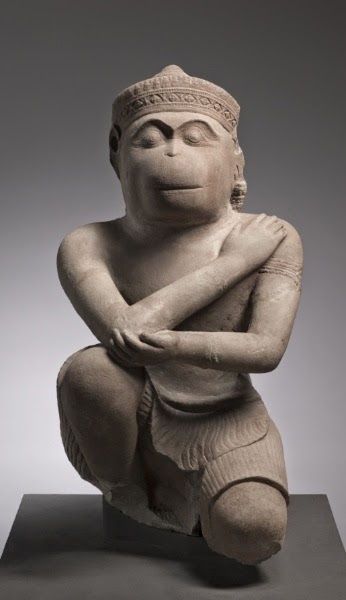
This month, the Cleveland Museum announced that after lengthy investigations they have determined that the statue is not from from Prasat Chen.
The Plain Dealer reports:
During the winter, the museum sent curator Sonya Rhie Quintanilla to Prasat Chen, a site of temple ruins 180 miles northwest of Phnom Penh.
Based on her research, the museum said it has ruled out Prasat Chen as the sculpture's original location, although it said it could not rule out the possibility that it may been removed illegally from some other site.
To check whether the work came from Prasat Chen, Quintanilla, the museum's curator of Indian and Southeast Asian art, carried in her luggage a lightweight plastic resin facsimile of the base of the Cleveland sculpture.
When she reached the site, where a thousand-year-old temple features sculptures that narrate Hindu legends, she said she found that the facsimile did not fit the two spots where the museum's Hanuman sculpture logically might have been located.While perhaps some kudos to the museum for doing some homework, is it really sufficient to say that the statue was not looted because it doesn't fit onto a particular base? I would have expected the museum to concentrate on proving the statue's provenance by reference to its ownership history. Who sold it to the museum? What background checks were performed? etc.
And, granted, the museum is said to be looking into this too. Nevertheless, it seems a bit premature to say the statue is not from Cambodia based on....essentially...a base.
Source: The New York Times, 20 May 2013, The Plain Dealer, 13 May 2014
Wednesday, 21 May 2014
Not an easy snatch and grab
A thief managed to make off with a piece of a copper sculpture as it was being installed in a New York park.
The piece was part of an exhibition of Vietnamese artist Danh Vo's work "We the People", organised by the Public Art Fund. We the People is a life-size replica of Frédéric Auguste Bartholdi’s Statue of Liberty, recreated by Danh Vo in about 250 individual pieces.
MyFoxNY reports that the robbery took place last week in City Hall Park - one of the locations of the exhibition, which was due to open on 17 May. The piece taken was a large, chain link section made of copper resembling a portion of the Statue of Liberty's foot. It is said to weigh about 40lbs and be worth about $6,000.
It does not appear that the theft has impacted on the opening of the exhibition, which can now be seen in both City Hall Park and Brooklyn Bridge Park. The police are investigating.
More details on the exhibition can be found here.
The piece was part of an exhibition of Vietnamese artist Danh Vo's work "We the People", organised by the Public Art Fund. We the People is a life-size replica of Frédéric Auguste Bartholdi’s Statue of Liberty, recreated by Danh Vo in about 250 individual pieces.
 |
| One part of We the People |
It does not appear that the theft has impacted on the opening of the exhibition, which can now be seen in both City Hall Park and Brooklyn Bridge Park. The police are investigating.
More details on the exhibition can be found here.
Monday, 21 April 2014
U.S. Federal Government Seeks Return of New Deal Artworks

Recovered Artwork: L. Lavelle, House on the Hill
During the Great Depression the U.S. government enacted many federal programs to aid the public by creating jobs for unemployed Americans, all part of President Roosevelt's New Deal. Among them were programs developed specifically for artists and writers. Under the Works Progress Administration Federal Art Project artists earned $42 each week for creating art that documented the nation, and these works became the property of the federal government. The pieces were displayed in libraries, courthouses, and other public facilities. It is estimated that as many as ten thousands artists participated in the program, generating hundreds of thousands of artworks. Since the 1930's and 40's however, many of the works have been misplaced, lost, or stolen. WPA Paintings and sculptures are now scattered across the United States, turning up at garage sales, antique shows, online, and on the auction block. Many of the works bear a marking indicating that they were produced under the federal program, however not everyone handling the works understands that such labels still carry meaning as to the ownership of the pieces.
Acknowledging not just the fact that the government "owns" the works, but that the works are integrally important to the artistic and cultural history of the United States, since 2001 the federal government has mounted efforts to verify and recover the works. The Government Services Administration in cooperation with other federal agencies including the FBI, continue to monitor and investigate, having established means for the public to call or email with reports of possible WPA artworks. The program continues to gain momentum and will remain in effect until all the works are accounted for. In 2011 the GSA produced a short documentary film regarding its efforts that is available to watch here. The film includes images of recovered works and interviews with possessors (those who had WPA artworks in their possession). One aspect of the recovery effort that is particularly interesting is the cooperation between the government and those possessing the works to find a mutually agreeable place for public display. Indeed as one government interviewee stated of recovered artworks, "It doesn't belong in a federal warehouse anymore than it belongs in a private collection."
The GSA's recovery efforts were also recently covered by NPR's All Things Considered, and a brief audio piece is available here.
Saturday, 12 April 2014
Priceless art discovered in US storage facility
Almost 80 paintings which went missing in 1998 have been uncovered by the FBI in a storage facility in the San Francisco Bay Area.
The artworks were all created by Polish artist Hanna "Kali" Weynerowska. Before she died, she bequeathed all the works to a Polish museum in Switzerland. At this point, it seems, the paintings all mysteriously disappeared. It was not until a few years ago, when the Polish Ministry of Culture established a fund to locate them, that the search for the artworks was reignited.
The San Francisco Chronicle reports that:
Source: San Francisco Chronicle, 12 April 2014
The artworks were all created by Polish artist Hanna "Kali" Weynerowska. Before she died, she bequeathed all the works to a Polish museum in Switzerland. At this point, it seems, the paintings all mysteriously disappeared. It was not until a few years ago, when the Polish Ministry of Culture established a fund to locate them, that the search for the artworks was reignited.
The San Francisco Chronicle reports that:
"...the FBI, contacted by the Polish government, tracked down a relative who led agents to a storage facility in Santa Rosa that held 75 Weynerowska originals. On Thursday, they arrived at the museum in Rapperswil, Switzerland, where Polish and U.S officials will attend a Ceremony of Restitution on June 16.
The paintings, in the artist's distinctive pointillist style, have such titles as "Boy on Donkey," "The Cobbler" and "Walking a Bird." Their financial value is modest, perhaps $12,000 each, but "they are priceless emotionally ... very important to the legacy of Polish excellence," Caria Tomczykowska, an envoy of the Polish Consulate in Los Angeles, said Friday at a San Francisco news conference called by the FBI.
"The FBI is proud to stand shoulder-to-shoulder with our Polish counterparts in ensuring safe passage of these lost national treasures," said David Johnson, special agent in charge of the FBI's San Francisco office.
He said the male relative, whom he didn't identify, had handed the paintings over voluntarily and isn't in legal trouble. Despite the artist's bequest, Johnson said one or more of her local relatives had apparently held on to the works since 1998 because of the costs of shipping them, and "perhaps a bit of emotional attachment."All's well that ends well. It does, however, seem very odd that the FBI and Polish governmental institutions were required to intervene to recover the paintings which were actually just being held by Weynerowska's relatives. Efficient allocation of resources??
Source: San Francisco Chronicle, 12 April 2014
Wednesday, 26 March 2014
Auction Houses already moving against ART Act
Since the American Royalties Too Act was introduced in the US Senate at the end of last month, it appears that Sotheby's and Christie's have already stepped up their lobbying efforts in Washington DC, with Sotheby’s sending lawyers to visit some lawmakers in the Capitol. Indeed, the New York Times notes that "Sotheby’s and Christie’s have spent about $1 million in the last couple of years to hire well-known legal and lobbying talent in Washington..."
In light of the failure of the earlier version of the bill (the Equity for Visual Artists Act), supporters of the ART Act have a tough fight ahead to get it through. However, Sotheby's and Christie's clearly do not want to take any chances.
The auction houses' arguments against a resale royalty are essentially the same as those that have been trotted out in other countries around the world against equivalent laws: that the royalty would damage the art market with little benefit to the majority of artists. However, while there may be artists who support the claim that they see little benefit from the right, there has still not been conclusive evidence to show that an artist's resale right has an negative effect on an art market.
It is still early days. Will it be best arguments or most money thrown at the issue that wins?
Source: The New York Times, 23 March 2014
Thursday, 6 March 2014
American Royalties Too Act
Thursday, 27 February 2014
An Artist's Resale Right in the US?
A new bill was introduced in the United States this week which aims to grant a resale right to artists in the US.
The bill, called the American Royalties Too Act [giving it the oh so clever abbreviation of ART Act], was introduced by US Senators Edward J. Markey (Mass.) and Tammy Baldwin (Wisc.) and Congressman Jerrold Nadler (NY).
A press release from Senator Markey explains the bill as follows:
The bill, called the American Royalties Too Act [giving it the oh so clever abbreviation of ART Act], was introduced by US Senators Edward J. Markey (Mass.) and Tammy Baldwin (Wisc.) and Congressman Jerrold Nadler (NY).
A press release from Senator Markey explains the bill as follows:
"Under current copyright law, visual artists – painters, sculptors, and photographers – are denied the ability to fully benefit from the success of their work over time. Unlike recording artists or publishers who, if successful, sell thousands of copies of their work and recoup a royalty from each purchase, artists sell their work only once. If they are successful, the price of their work increases but they recoup nothing if their original work is resold at a much higher price. The benefits derived from the appreciation in the price of a visual artists’ work typically accrues to collectors, auction houses, and galleries, not to the artist. In addition, United States artists are at a disadvantage in the global art market where more than 70 other countries have provided resale royalty rights for visual artists. The American Royalties, Too (ART) Act of 2014 remedies this inequity by providing a modest resale royalty right for visual artists.
The ART Act would:
· Provide a competitive resale royalty of five percent of the sales price (up to $35,000) for any work of visual art sold at auction for $5,000 or more.
· The resale royalty [would apply] to any auction where the entity conducting the auction has sold at least $1 million of visual art during the previous year.
· Royalties [would be] collected by visual artists’ copyright collecting societies who [would be required to] distribute the royalties to the artists or their heirs at least four times per year.
· Allow US artists to collect resale royalties when their works [were] sold at auction in the EU and more than 70 other countries."The bill comes a little more than two months after the release by the US Copyright Office of its Report on Resale Royalties which concluded (among other things) that:
- The current US copyright system leaves many visual artists at a practical disadvantage in relation to other kinds of authors.
- To alleviate the effects of this financial disparity, Congress should consider ways to rectify the problem and to further incentivize and support the development and creation of visual art.
- The Copyright Office supports the consideration of a resale royalty right as one option to address the historic imbalance in the treatment of visual artists.
- There was no evidence that adoption of a resale royalty right would cause substantial harm to the US art market.
Friday, 7 February 2014
Gagosian not off the hook
The New York state Supreme Court in Manhattan has ruled that Larry Gagosian and Gagosian Gallery Inc. must continue to defend a fraud claim brought by Ronald Perelman.
By way of background, in September 2012, Perelman, an American businessman with a mere net worth of around US$14.1 billion, sued Gagosian Gallery Inc. and its founder and owner, Larry Gagosian alleging that they had "concealed material information from [Perelman] and used their dominant position in the contemporary art world to manipulate the price of a certain artwork in transactions with [Perelman] in gross violation of the fiduciary duties owed to [Perelman]."
Perelman brought claims for breach of contract, breach of fiduciary duty, fraud, breach of the covenant of good faith and fair dealing, unjust enrichment and deceptive business practices.
On the same day Gagosian sued Perelman, accusing him of reneging on an agreement to buy two works of art. In October 2012, however, the Gagosian parties dropped their suit and subsequently filed a motion to dismiss all of Perelman’s claims.
Unfortunately for Gagosian, while New York State Supreme Justice Barbara Kapnick dismissed the majority of the charges (in her decision of 31 January 2104), she ruled that the fraud claim may stand.
Businessweek reports:
Gagosian has 30 days (from 31 January) to file and serve an Answer to the fraud claim.
Perhaps most interesting is the power and influence that one individual is said to wield in the art world - and the other scary insights into the art world that the case provides. Details can be found in the initial complaint and amended complaint.
Source: Businessweek, 4 February 2014
By way of background, in September 2012, Perelman, an American businessman with a mere net worth of around US$14.1 billion, sued Gagosian Gallery Inc. and its founder and owner, Larry Gagosian alleging that they had "concealed material information from [Perelman] and used their dominant position in the contemporary art world to manipulate the price of a certain artwork in transactions with [Perelman] in gross violation of the fiduciary duties owed to [Perelman]."
Perelman brought claims for breach of contract, breach of fiduciary duty, fraud, breach of the covenant of good faith and fair dealing, unjust enrichment and deceptive business practices.
On the same day Gagosian sued Perelman, accusing him of reneging on an agreement to buy two works of art. In October 2012, however, the Gagosian parties dropped their suit and subsequently filed a motion to dismiss all of Perelman’s claims.
Unfortunately for Gagosian, while New York State Supreme Justice Barbara Kapnick dismissed the majority of the charges (in her decision of 31 January 2104), she ruled that the fraud claim may stand.
Businessweek reports:
The judge said that while the plaintiffs, Perelman’s MAFG Art Fund and MacAndrews & Forbes Group LLC, are “experienced and sophisticated” business investors, the allegation that Gagosian and his gallery had “superior and unique” knowledge of the art world is enough for the fraud claim to survive.
“Plaintiffs allege that Gagosian has enormous power to influence, and even set, the markets for the artists he represents because of his impressive roster of artists and his access to and knowledge of the largest private art collections in the world,” Kapnick wrote. “Even though the plaintiffs are sophisticated art collectors and investors, the court cannot say, as a matter of law, that plaintiffs’ alleged reliance on defendants’ representations regarding the art market and intrinsic value of particular works of art was per se unreasonable or unjustified.”The full decision can be found here.
Gagosian has 30 days (from 31 January) to file and serve an Answer to the fraud claim.
Perhaps most interesting is the power and influence that one individual is said to wield in the art world - and the other scary insights into the art world that the case provides. Details can be found in the initial complaint and amended complaint.
Source: Businessweek, 4 February 2014
Subscribe to:
Posts (Atom)