Wednesday, 6 August 2014

Arts Council England strips museums of their Accreditation

The Arts Council England (ACE), through its Accreditation Scheme, sets nationally agreed standards for museums in the UK.

According to the ACE:
"Accreditation is the UK standard for museums and galleries. It defines good practice and identifies agreed standards, thereby encouraging development. It is a baseline quality standard that helps guide museums to be the best they can be, for current and future users." 
"Accreditation enables museums and governing bodies to assess their current performance, and it supports them in planning and developing their services." 
Unfortunately for two local museums, it seems that they were not up to standard. At the beginning of this month, the ACE stripped both the Northampton Museum and Art Gallery and the Abington Park Museum of their Accreditation

The Museums Association Journal explains:
Arts Council England (ACE) announced today that it has stripped Northampton Museums Service of Accreditation following the disposal of the ancient Egyptian statue Sekhemka.
Northampton Borough Council controversially sold the statue for £15.8m at auction last month and will take home £8m of the proceeds. The remaining share will go to Lord Northampton, whose ancestors donated the statue to the museum. 
 
Following a hearing last week, the arts council’s Accreditation panel found that the process leading up to the sale and the sale itself were in contravention of the Accreditation standard.
In a statement today, the arts council said: “As a result of this non-compliance the two museums managed by Northampton Borough Council, Northampton Museum and Art Gallery and Abington Park Museum, have been removed from the Accreditation scheme, effective as of 1 August 2014, and excluded from future participation for a minimum period of five years, until at least August 2019.” 
It is reported that the museums were warned that sale of the statue could lead to them losing their Accreditation status. There were also protests outside Christie's prior to the sale calling for the statue to be returned to Egypt if the Council did not want it. Nevertheless, they went ahead and sold it.

The loss of the ACE Accreditation is likely to affect the museums' ability to apply for future grants and funding. It remains to be seen whether it was worth it.

Source: The Museums Association, 1 August 2014, BBC News 1 August 2014

Tuesday, 5 August 2014

Artist's Estate Sues Chelsea Hotel

The famous Chelsea Hotel in New York has been a setting for many a scandal. The last few years have seen comparatively milder wranglings over the artworks that used to hang in the hotel, prior to its sale in 2011.

The most recent case to be filed is a claim by the Larry Rivers Foundation (representing late American artist Larry Rivers) against the new owners of the Chelsea Hotel seeking recovery of a Rivers' painting that, the Foundation alleges, was loaned to the hotel for exhibition purposes only.

The Courthouse News Service provides further details.
Rivers [had previously] loaned another work in its series, De Kooning's Father: Portrait of Arshile Gorky," to the hotel, which hung prominently in its lobby before being sold to a third party, according to the complaint.
The foundation claims that Rivers loaned, but never intended to donate, "Dutch Masters" to replace that work. " 
After Dutch Masters was installed at the Chelsea Hotel, managers of the Chelsea Hotel asked Larry Rivers to donate Dutch Masters to the Chelsea Hotel and Larry Rivers refused that request," the complaint states. 
After Rivers died in 2002, his foundation received the title to "Dutch Masters."
It was not, however, until the hotel was sold that the Foundation asserted ownership and tried to recover the painting. After several years with no success, the Foundation was left with little option but to bring this recent claim seeking return of the painting and at least $250,000 in damages for conversion and unjust enrichment.

Considering some of the stories surrounding other paintings which went missing at the same time, success in the claim might not necessarily mean recovery of the painting. But let's hope that this piece was not just thrown in the bin.

Source: Courthouse News Service, 31 July 2014

Monday, 4 August 2014

No copyright on milk crate?

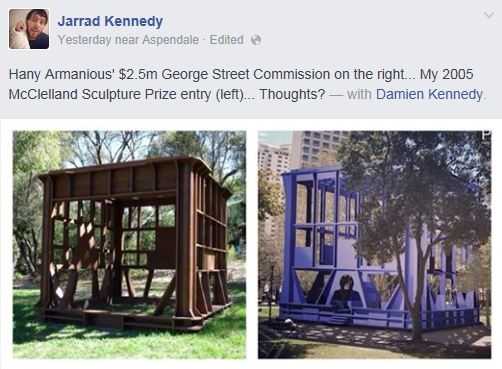
On his Facebook page, the Melbourne artist Jarred Kennedy recently claimed that Hany Armanious' new artwork - a giant milk crate - looks similar to his sculpture, the 2005 McClelland Sculpture Prize entry.

Kennedy's post on his Facebook page

Last Wednesday, three public artworks were revealed by Sydney Lord Mayor, Clover Moore, including Hany Armanious' giant 13.7 metre high milk crate 'Pavilion', which the Sydney council decided to install in Belmore Park, near Central Station.

Armanious, whose giant crate is accused of infringing the copyright in Kennedy's work, is one of Sydney's most respected contemporary sculptors and a globally recognised talent. When Armanious submitted 'Pavilion' for review by Sydney's City Centre Public Art Evaluation Panel, it garnered praise from panel member Lisa Havilah, director of Carriageworks. She said that "Sydney is full of milk crates and there was something wonderfully irreverent about making one 40 times larger that people can enjoy in a park".

Kennedy sent a letter to the City of Sydney and to Amarnious with reference to the alleged copyright infringement. The City of Sydney responded with the statement that a copyright infringement needs some act of copying and Kennedy will have to prove that Armanious had previously seen his milk crate.

While the question of whether Armanious' blue milk crate does infringe upon Kennedy's intellectual property rights remains to be answered, this episode leads to the question of the extent to which the law will protect artistic originality. Adaptation and appropriation of previous works by artists have become increasingly accepted by the artistic community, as we saw already in some posts here and here, for instance, in the Cariou v Prince case.

Where do we draw the line between inspiration and imitation?

Tuesday, 22 July 2014

Print-a-Pony: golden opportunity, or taking artwork for a ride?

Printed in 3D, they may never look the same again
With apologies for the cross-post, there follows the first part of a blogpost from Iona Silverman on the 1709 Blog, "My Little Pony Gets 3D Printed", here, which focuses on some of the copyright issues arising from a fascinating piece of commercial cooperation 
"3D printing is a bit of a buzzword at the moment and its not the first time that this blogger has written about protection of IP rights in the 3D printer world. Rightsholders need to be thinking about how best to exploit 3D printing rather than how to avoid it, and one company that has done just that is Hasbro. 

Rather than targeting creators of fan art to stop them customising the popular My Little Pony range (because, really trying to stop your fans from enjoying your product is not a great business proposition), Hasbro is going to partner with 3D printing company Shapeways to sell fan art.

Five artists will design My Little Pony figurines which can be printed to order. John Frascott, chief marketing officer at Hasbro, describes the process as "mass customisation" - the figurines don't make sense for mass manufacture but enough people will buy them that Hasbro can justify allowing the artists to create and sell them.

It's not clear whether the artists will be employed by Hasbro or whether they are merely granted permission to create fan art (likely the former, for Hasbro to retain control of any copyright created) but it is clear that this is a clear demonstration that we will see more and more customised goods in future, meaning more and more 3D printing. ..."
Iona then goes on to ask a number of copyright-related questions, as one might expect in a piece written for a copyright law blog, and readers can consider those issues at their leisure.  From the perspective of Art & Artifice, however, it would be good to get some reactions from artists and those who represent them as to what this ingenious use of a 3D-based business opportunity might make to them

Monday, 21 July 2014

Fair Use in the Visual Trenches

I've recently been preparing to teach a class on intellectual property to visual artists in Seattle. As I gathered information and images for a slide show, I wondered how to explain to working artists (in the course of a few hours no less) why this is fair use:


And this is not.


Yes, we can talk about the four main factors in a fair use analysis and, of course, transformativeness and parody, but practically speaking how is a working artist to put this to use? If lawyers and judges can't agree, or even explain the concept without discussing how vague and opaque the fair use doctrine is, what is an artist to do?

During my research I located a January 2014 Fair Use Report prepared for the College Art Association. The report addresses concerns that fair use is underutilized by the visual arts community due to confusion and fear about copyright infringement.

Some of the key findings and figures are summarized in the report as follows:
"Visual artists and other visual arts professionals, a term used in this report to include (among others) art historians, educators, professors, editors or publishers, museum professionals, and gallerists, share a common problem in creating and circulating their work: confusion and misunderstanding of the nature of copyright law and the availability of fair use—the limited right to reuse copyrighted material without permission or payment.

Fair use is flexible, available, and even core to the missions of many visual arts activities. 

Members of the visual arts communities typically overestimate the risk of employing fair use, which leads them to avoid it, even in circumstances where the law permits and so doing would not harm personal relationships necessary for their work.

They pay a high price for copyright confusion and misunderstanding. Their work is constrained and censored, most powerfully by themselves, because of that confusion and the resulting fear and anxiety.”
The report further found that approximately one third of those in the field had abandoned or declined to undertake certain projects due to copyright issues, this includes museums failing to digitize collections, curators declining to do shows where copyright permissions may be an issue, and artists who avoid collage and other types of appropriation art.

While I agree that fair use is flexible and available, it is perhaps the doctrine's over-flexibility that has led to many of these problems. Couple this with copyrights of expansive duration, lack of guidance with respect to orphan works, and at times avid copyright enforcement, and it is no wonder that some artists are avoiding the fair use morass all together. The outcome of these matters is so often unpredictable, and the courts' lack of consistency in application has left us with a hyper-flexible fair use doctrine and vague best practices.

Of course, this is not to say artists should be voluntarily ignorant and fearful of copyright law. Education about copyright serves as an extremely valuable tool in preventing unnecessary self-censorship and allows artists to understand and assess on their own terms the risks associated with particular uses of copyright-protected materials. Indeed artists should have an understanding that they themselves are the beneficiaries (not just the victims) of copyright protection and all the rights and opportunities associated therewith.

Friday, 18 July 2014

A&A at The John Marshall Law School Review of Intellectual Property Law 6th Annual Symposium


I am very pleased to report that on October 24, 2014 I will be speaking at The John Marshall Law School Review of Intellectual Property Law Sixth Annual Symposium in Chicago.  The focus of this year's symposium is the intersection of art and intellectual property.  I will be speaking on appropriation art, in particular legal issues related to art's own self-appropriation.

Thursday, 17 July 2014

In the Washington Post, David Montgomery reports on a fascinating episode in the tale of contemporary art curatorship. In "Corcoran breakup plan backed by District ahead of hearing; critics seek alternative" he explains that the Corcoran Gallery of Art and Design's dramatic plan to dissolve and reorganize itself with new custodians has received support in the form of an endorsement by District Attorney General Irvin B. Nathan. The Corcoran is Washington DC's oldest private art museum but it has been facing severe financial problems in recent years. Its reorganisation proposal -- which would involve transferring its art college operations to George Washington University and passing a sizeable proportion of its 17,000 artworks to the National Gallery of Art has attracted hundreds of pages of court briefs, not to mention submissions from 53 individuals in their capacity as members of the public.

A public hearing is set for 2:30 pm this Friday before Judge Robert Okun, though it is unclear whether he will give a ruling straight away, delay it or order further proceedings.

Thursday, 10 July 2014

Latest from Detroit

When we last caught up on the situation, creditors of the city of Detroit were looking to the Detroit Institute of Arts (DIA) collection as a source of cash, and experts had been hired by the DIA and the City to value the collection.

By the latest report, however, it seems that although the collection may be worth as much as $4.6bn, a sale of the artworks would not raise enough to pay the City's creditors.

The report in question was produced by Michael Plummer of Artvest Partners LLC, who was hired by the DIA to provide an expert opinion on:
  1. The indicative value of the works in the DIA Collection; 
  2. The feasibility and likely effects on the market and value realization of a sale of the DIA Collection under a variety of market and sale conditions;
  3. Creditor-proposed sales of the DIA Collection;
  4. Monetization alternatives described in Christie's report to the City of Detroit; and
  5. Infirmities in any rebuttal expert reports
What Plummer concludes in the report (dated 8 July 2014) is that:
Rather than being a source of cash to creditors or a burden on the current city. In fact the DIA is the single most important cultural asset the City currently owns for rebuilding the vitality of the city. 
In response to the report, a spokesman for Kevyn Orr, the emergency financial manager for Detroit, said "The report makes it abundantly clear that selling art to settle debt will not generate the kind of revenue the city's creditors claim it will."

Whether the report will stop the creditors from chasing is another matter.

We previously reported that the next major stage of this saga is the trial to determine the fairness and feasibility of the restructuring plan submitted by the City, which was scheduled to start on 24 July. According to the Guardian, however, a federal judge overseeing Detroit's bankruptcy has scheduled the next hearing to start on 14 August 2014.

Read the full report here.
Source: The Guardian, 9 July 2014

Friday, 27 June 2014

Ownership of Nazi-looted art at Pasadena Norton Simon Museum disputed

Another post on Art & Artifice on looted art.

This case concerns two sixteenth-century oil paintings looted in 1940 from the collection of a noted Dutch art collector and dealer, Jacques Goudstikker. The two paintings "Adam" and "Eve" by Lucas Cranach the Elder were acquired by the Norton Simon Museum of Art in Pasadena, California in 1971 and, to date, have regularly been on display.

In May of 2007, Marei von Saher, Jacques Goudstikker's sole heir, filed a complaint in the Federal Court for the Central District of California seeking to recover the paintings.

The history of the two paintings is complicated by multiple lootings and suspicious changes-of-hand.

Before the 20th century, the diptych was in a Kiev Church for more than 400 years, until the Soviets moved the works to the Art museum of the Ukranian Academy of Science. Then, the Soviet government decided to auction the works in Berlin where the Jewish art dealer, Jacques Goudstikker, bought them in 1931.

During World War II, in 1940, Mr Goudstikker fled the Netherlands when Germany invaded and died while crossing the Atlantic to South America. Several hundreds of works in his gallery, including the two Cranach paintings, were later sold in two circumstances: to the German bank Alois Miedl during an auction, and to the Nazi Reichsmarschall Hermann Göring at a fraction of their value.

At the end of the World War II, the works were eventually restituted to the Dutch government in 1946 by the Monuments Men.

Goudstikker’s widow filed timely claims with the Dutch government and reached a settlement in 1952. Under that settlement, she received most of the property taken by Alois Miedl, but the agreement did not cover the artworks taken by Göring.

The paintings were then the subject of a claim concerning Goudstikker’s initial acquisition from the Soviet Union. A Mr George Stroganoff-Scherbatoff successfully petitioned the Dutch government to return the paintings to him on the grounds that the Soviet Union had illegally taken the works from his Russian family before Goudstikked bought them. So, in 1966, the Dutch government quietly gifted the work back to George Stroganoff-Scherbatoff, denying the restitution claims by Goudstikker’s wife. Then, in 1971, the Norton Simon museum acquired the panels from George Stroganoff-Scherbatoff.

Finally, three decades later, Von Saher learned of the paintings whereabouts, and sued the Norton Simon Museum in 2007, after six years of talks failed to resolve the case.

In March 2012, US District Judge John Walter dismissed the case, finding that Von Saher's claims conflicted with US policy on recovered art.

However, on June 6, the 9th US Circuit Court of Appeals reversed the 2012 decision, returning the case to the District Court. 

Now we will have to wait and see whether the transfer to Stroganoff-Scherbatoff will be considered as a Dutch "act of state" that a US court should not disturb or not.

Tuesday, 24 June 2014

Israel and Germany agree to cooperate on looted art

This blog has often covered cases and disputes over art stolen from Jews during World War II.

The most recent news on this topic appears to be rather positive. Last week Israel and Germany signed an agreement under which joint-research will be conducted in museums in both countries to determine the provenance of art suspected to be Jewish-owned art looted during World War II.

The AFP reports that under the agreement, which was signed by the countries' respective Culture Ministers, art experts from Israel and Germany will undergo training and coordinate the formation of joint databases.

The agreement apparently formalises the ongoing cooperation between the two countries, which was particularly tested recently with the discovery of the "Gurlitt stash" (reported here, here and here).

German Culture Minister Monika Gruetters released a statement about the agreement, which says that the agreement represents a "huge vote of confidence" as Germany does not work with any other country in this way. The statement also provides further details as to how the agreement and cooperation between the countries is intended to work in practice. [Unfortunately it is in German, and that's about as far as my German goes. Curious German speakers can read the rest here.]

It will be interesting to see if there is any change to looted art cases going forward, in the wake of this agreement.