Showing posts with label book notice. Show all posts

Wednesday, 27 August 2014

Comic art, creativity and the law: a new title

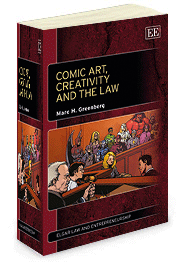
Comic Art, Creativity And The Law, by Marc H. Greenberg (Professor of Law, Golden Gate University School of Law, US), has been recently published by Anglo-American publishing house Edward Elgar as part of its ever-increasing IP list, as part of its Law and Entrepreneurship series. According to the publisher:
The characters and stories found in comic art play a dominant role in contemporary popular culture throughout the world. In this first-of-its-kind work, Comic Art, Creativity and the Law examines how law and legal doctrine shapes the creative process as applied to comic art.

The book examines the impact of contract law, copyright law (including termination rights, parody and ownership of characters), tax law and obscenity law has on the creative process. It considers how these laws enhance and constrain the process of creating comic art by examining the effect their often inconsistent and incoherent application has had on the lives of creators, retailers and readers of comic art. It uniquely explains the disparate results in two key comic book parody cases, the Winter Brothers case and the Air Pirates case, offering an explanation for the seemingly inconsistent results in those cases. Finally, it offers a detailed discussion and analysis of the history and operation of the ‘work for hire’ doctrine in copyright law and its effect on comic art creators.

Designed for academics, practitioners, students and fans of comic art, the book offers proposals for changes in those laws that constrain the creative process, as well as a glimpse into the future of comic art and the law.
This is an enjoyable and thoughtful book, part legal analysis, part history, part speculation and part personal reflection. The impact of the law on the fruits of creation is easier to assess than its impact on those aspects of creativity which it may deter or stifle, and the use of comic art as a powerful form of parody, satire or social comment keeps returning it to the point at which freedom of expression meets countervailing rights and interests -- but this book is neither repetitive nor preachy, even though Marc Greenberg never leaves it to his readers to guess his thoughts and feelings.

Apart from Justin Hughes' encomium, there is no mention of the words "United" and "States" in conjunction with one another and, though there is the occasional reference to some non-US issue, the text is unashamedly US focused, sparing just six pages towards the end for an acknowledgement of the Franco-Belgian and Japanese traditions.  This is not a crime, of course, but it would be appreciated if publishers were to flag single-jurisdictional works as being so, in order that readers and potential purchasers should not be encouraged to think of the work as having some sort of international significance.  For the past 20 years, entrepreneurship in fields like comic art and, dare one say it, creativity, has been looking increasingly to the internet for commercial routes to exploitation, and the internet is not coterminous with the borders of the United States. It is hoped that future editions of this worthwhile and enjoyable book will either be encouraged to spread their focus a little wider or will clearly indicate that they don't.

There's one final, trivial quibble: the illustration on the publisher's website, reproduced above, creates the impression that this book is thicker than it actually is. Following xix pages of preliminaries, the text -- inclusive of the index -- totals just 199 pages.

Bibliographic data: hardback ISBN 978 1 78195 492 8; ebook ISBN 978 1 78195 493 5. Hardback price£70 (online from the publisher, £63). Web page here.

Tuesday, 29 October 2013

Freedom of artistic expression: a new book

Freedom of Artistic Expression: Essays on Culture and Legal Censure, by Paul Kearns, is a handsome and readable volume of thoughtful pieces published by Hart Publishing. The author is a Senior Lecturer in Law in the University of Manchester, where he teaches Public International Law, Human Rights Law and, as a specialist yet popular topic, Law, Literature and Art.

According to the book's website:
"This book presents a unique and comprehensive examination of the human and moral rights of artists. In what is arguably the first exhaustive book-length account of artists' rights, Paul Kearns explores the problems associated with censorship, both from philosophical and legal perspectives, and focuses on the various ways in which the morality of art is legally regulated in different jurisdictions. In relation to human rights, English, French and American law, the law of the European Convention on Human Rights, European Union law and public international law are all closely scrutinised to discover the extent to which they offer protection for artistic freedom. The author also examines domestic and international law in respect of artists' moral rights, the law of copyright and related laws. In short, the book provides an original, and sometimes controversial, analysis of persistent concerns regarding the legal regulation of the arts universally, doctrinally and theoretically, and seeks to offer an holistic treatment which will appeal to art lawyers, artists and those interested in the future of the arts".
This blogger was quite surprised at how much there remains to be said on the subject, even in the permissive era of the twenty-first century. This book will repay the reader's attention with its measured and well-informed approach to the topic.

The hardback version of this book (x + 249 pages) is already available (ISBN 9781841130804) at £50; Adobe and ebook versions are forthcoming at £36 each.

Friday, 10 May 2013

New book coming out on legal dimensions of art collecting

The Art Collecting Legal Handbook, edited by Bruno Boesch and Massimo Sterpi, has just been published by Sweet & Maxwell.  Art & Artifice looks forward to reviewing this title in due course, not least since this blogger is a great admirer of Jacobacci Avvocati partner Massimo Sterpi -- a tireless visionary and enthusiast who currently serves on the Council of MARQUES, the European trade mark organisation. In this venture Massimo teams up with Bruno Boesch, a partner in the Swiss law practice of Froriep Renggli and an expert in the highly specialist area of long-term art collection care. The editors have put together an impressive team spanning the best part of 30 countries, including both those in which famous collections are built up and those from which many collectables originate.

This is what the publishers say about this work, which is published at the end of May:
Collecting, preserving and promoting cultural goods, whether fine art, archaeological objects or decorative arts, is now global. Oddly, rules and practices have remained very local, save for ICOM’s efforts at the institutional level and UNESCO’s endeavours to help preserve national cultural heritage and combat illicit trafficking.

This book is designed to help the collector and their advisers navigate the maze on an international level. Each chapter of The Art Collecting Manual addresses a number of issues from the perspective of a different jurisdiction to help collectors making errors that could be potenitally illegal. The format of the chapters follow a question and answer style thus enabling readers to make quick and accurate comparisons in multiple jurisdictions covering property law, insurance, customs, tax, inheritance, intellectual property and more.

A collectable in itself, this title crosses the line between highly functional and aesthetically pleasing, the perfect addition for anyone who works in international art dealings".
Apart from this, there's some further information as to what the book covers:
• Cultural Heritage and Art Market: regulations; legislation features and treaties; data about art and cultural property market: trade volume; dealers 
• Purchase and Export: due diligence, local law features; remedies in case of fake, forgery or counterfeit; VAT/sales tax; artist’s resale right; export restrictions; “free ports” 
• Peaceful Enjoyment: import customs; protection against claims; restitution assistance; repatriation of illegally exported cultural property; anti-seizure guarantee 
• Sale: due diligence; temporary import for sale; remedies against a defaulting buyer 
• Art Philanthropy: rules and practices; private foundations and museums 
• Tax: wealth tax; capital gain tax; inheritance tax; tax breaks; taxation of private foundations and private museums 
• Practical information/references
Bibliographic details: hardback, ISBN 9780414026933.  Price: £80. Book's web page here.

Exciting news: our very own Angela Saltarelli has co-authored the Italian chapter of this book together with Massimo Sterpi.

Monday, 24 December 2012

Faking It: a new book

Faking It: Manipulated Photography before Photoshop, by Mia Fineman, is a handsome tome that will be at home on any coffee-table. Published by the Metropolitan Museum of Art, which is currently hosting an exhibition on this very theme, and distributed by Yale Books, this book is the fruit of the labours of the assistant curator in the department of photographs at The Metropolitan Museum of Art, and a tribute to her endeavours, her enthusiasm and her excellence.  As the book's web-blurb explains:
"It is a long-held truism that 'the camera does not lie'. Yet, as Mia Fineman argues in this illuminating volume, that statement contains its own share of untruth. While modern technological innovations, such as Adobe's Photoshop software, have accustomed viewers to more obvious levels of image manipulation, the practice of "doctoring" photographs has in fact existed since the medium was invented. In "Faking It", Fineman demonstrates that today's digitally manipulated images are part of a continuum that begins with the earliest years of photography, encompassing methods as diverse as overpainting, multiple exposure, negative retouching, combination printing, and photomontage. Among the book's revelations are previously unknown and never before published images that document the acts of manipulation behind two canonical works of modern photography: one blatantly fantastical (Yves Klein's "Leap into the Void" of 1960); the other a purportedly unadulterated record of a real place in time (Paul Strand's "City Hall Park" of 1915). Featuring 160 captivating pictures created between the 1840s and 1990s in the service of art, politics, news, entertainment, and commerce, "Faking It" provides an essential counterhistory of photography as an inspired blend of fabricated truths and artful falsehoods".
For the trial lawyer, who -- to be fair -- is not this book's prime readership target -- the text raises questions of the credibility of photographs as primary or corroborative evidence both in civil proceedings and in criminal trials.  For the intellectual property lawyer the book raises further and deeper issues relating to the moral rights of a photographer to object to the distortion of his or her work and to disassociated from its manipulated version, as well as to the treatment of orphan works.  On the same page as the copyright notice, the reader will find the following message:
"Unless otherwise specified, all photographs were supplied by the owners of the works of art, who hold the copyright thereto, and are reproduced with permission. We have made every effort to obtain permission for all copyright-protected images.  If you have copyright-protected work in this publication and you have not given us permission, please contact the Metropolitan Museum's Editorial Department ...".
From this it appears that the Museum has not found the absence of a legislative solution to the 'orphan works' problem to be an insuperable barrier to its commercial objective in publishing this book.

Further particulars of this lovely book can be found here.