Showing posts with label appropriation. Show all posts

Monday, 4 August 2014

No copyright on milk crate?

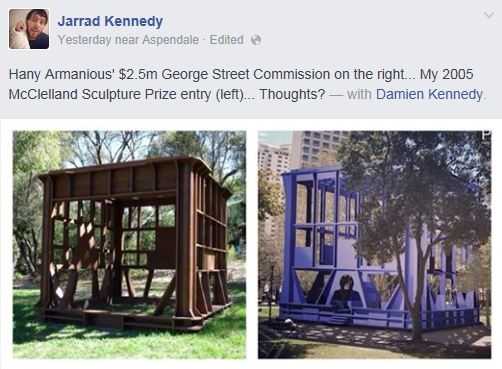
On his Facebook page, the Melbourne artist Jarred Kennedy recently claimed that Hany Armanious' new artwork - a giant milk crate - looks similar to his sculpture, the 2005 McClelland Sculpture Prize entry.

Kennedy's post on his Facebook page

Last Wednesday, three public artworks were revealed by Sydney Lord Mayor, Clover Moore, including Hany Armanious' giant 13.7 metre high milk crate 'Pavilion', which the Sydney council decided to install in Belmore Park, near Central Station.

Armanious, whose giant crate is accused of infringing the copyright in Kennedy's work, is one of Sydney's most respected contemporary sculptors and a globally recognised talent. When Armanious submitted 'Pavilion' for review by Sydney's City Centre Public Art Evaluation Panel, it garnered praise from panel member Lisa Havilah, director of Carriageworks. She said that "Sydney is full of milk crates and there was something wonderfully irreverent about making one 40 times larger that people can enjoy in a park".

Kennedy sent a letter to the City of Sydney and to Amarnious with reference to the alleged copyright infringement. The City of Sydney responded with the statement that a copyright infringement needs some act of copying and Kennedy will have to prove that Armanious had previously seen his milk crate.

While the question of whether Armanious' blue milk crate does infringe upon Kennedy's intellectual property rights remains to be answered, this episode leads to the question of the extent to which the law will protect artistic originality. Adaptation and appropriation of previous works by artists have become increasingly accepted by the artistic community, as we saw already in some posts here and here, for instance, in the Cariou v Prince case.

Where do we draw the line between inspiration and imitation?

Wednesday, 24 April 2013

Appropriating the copyright symbol: van Roeyen on Scholte

Via a recent Tweet this blogger found himself browsing through the frames of a PowerPoint presentation by his friend Gino van Roeyen (Banning), an engaging and enthusiastic Dutch IP lawyer with whom one's time is generally spent both productively and enjoyably.  By way of introduction to the lecture for which these frames were prepared, Gino explains:
"Although art is generally considered to be the territory of absolute freedom in which creativity should thrive optimal, it can also be the arena of virulent copyright battles. As copyright in a work of art protects against publication and reproduction of that work (including reproductions that cannot be regarded original themselves) without permission of the copyright owner, unauthorized occupation of such a work might be regarded as a declaration of war against the copyright owner. It might ask for forms of retaliation, varying from cease and desist letters to litigation in court. 
Of course, the art of retaliation may depend on the gravity of the infringement. Straightforward pirates (copycats) might risk severe measures of retaliation, like destruction of counterfeit works of art and penalties. But what to do with works of art that are not copies of the original, being in one way or another ‘linked’ to the original?  So called appropriation art cultivates what already exists into art.  This might also involve works of art which are protected by copyright, but also other tangible objects that can be the object of a copyright (like for example the design of a simple household issue like a towel). 
In this lecture this phenomenon will be examined and explained closely by means of several examples of copyright battles in the arts throughout the years. Since Rob Scholte -- who can be regarded as an acclaimed and famous supporter of ‘appropriation’ in art -- will be the keynote speaker at the conference, the lecture will also focus on his work, like for example his famous © work, in which Scholte appropriated the © sign, a sign which can be used freely to denote that copyright is claimed for a work. Paradoxically by inserting the © into his own work – or should we say by reconstructing the © into a work of art – Scholte created a work which is protected by copyright'".

Thursday, 1 December 2011

What we talk about when we talk about appropriation

Back in March Art & Artifice posted this piece on Cariou v Prince, in which a photographer, who had published a selection of his works in a book called Yes, Rasta, objected to what an appropriation artist considered to be fair transformative use of those photographs. This case and the legal issues it brought to light are the subject of a discussion, "What we talk about when we talk about appropriation: Contemporary Art After Cariou v. Prince". This is billed as "a frank discussion of fair use and artistic practice". Taking place in the Great Hall of the New York City Bar Association (that's on West 44th Street, between 5th and 6th Avenues)  on Tuesday 13 December, 2:00 - 4:00 pm, the programme examines this question:
Art and legal experts use similar terminology when talking about how artists use existing images, but are they speaking the same language?
The Panelists are Dan Cameron (Curator), Anthony Falzone (Stanford Fair Use Project), Claudia Ray (Kirkland & Ellis LLP), Walter Robinson (Artnet), Virginia Rutledge (PIPE Arts Group) and Hank Willis Thomas (Artist), with Amy J. Goldrich exercising a moderating influence.

Entrance is free and there is are registration formalities. If anyone attending the discussion would like to send Art & Artifice a little summary, we'd be delighted to see it!

More background on Cariou v Prince here and here