Showing posts with label Art Loss Register. Show all posts

Friday, 23 August 2013

Sotheby's sells stolen art

It appears that Sotheby's London sold a piece of art at auction at the end of June for over £180,000, despite having been informed by the Art Loss Register (ALR) that it was stolen.
The piece by Jan Schoonhoven, R69-32 (1969), was originally stolen from the Bommel van Dam museum in March this year (along with two other Schoonhoven works and a piece by Tomas Rajlich). The work was reportedly simply turned 90 degrees, and its name was slightly altered. This was apparently all that was needed to fool everyone...

Upon discovering that the piece was up for auction, the ALR, who had been alerted when the work was stolen, contacted Sotheby's and told them that it corresponded to a Schoonhoven relief in their database. Sotheby's response was that as the title of the work did not correspond to the title in the ALR database. Therefore, they proceeded to sell the piece at auction on 27 June to two art galleries who bought it together - the Mayor Gallery in London and the Borzo in Amsterdam.

It is reported that it was only when Paul van Rosmalen from the Borzo, who had been away when the work was purchased, became aware of the acquisition made in his absence that questions were raised. An expert on Schoonhoven, he found it strange that the work had been put up for sale and asked for more details from his London colleagues. Van Rosmalen said that, on review of the photos they sent him, it was very clear that the title of the work had been modified (from R69-32 to R69-39). The sale was then immediately annulled and an enquiry opened.

The whole affair, however, only became public last week, when it was reported that a man entered a police station in Amsterdam in possession of the two other Schoonhoven reliefs stolen at the same time. On questioning, he claimed to have bought the three works in good faith...for €100...and admitted selling one through Sotheby's.

But all is well that ends well...almost. The two works which were turned into the Dutch police have been returned to the Bommel van Dam museum, although the auctioned work is apparently still in London. Unfortunately the piece by Tomas Rajlich is still missing.

Source: Le Quotidien, 23 August 2013

Monday, 3 June 2013

Due regard for diligence

As a lawyer, due diligence is certainly one of my least favourite activities, but I accept that it can sometimes be crucial. This weekend, the Observer highlighted the importance of carrying out sufficient due diligence on potential art sales. It also emphasised the effectiveness of the Art Loss Register (ALR), which I discussed here back in 2010.

The Observer reports:
European auction houses, dealers and collectors are failing to make adequate checks to avoid handling stolen artworks, an art lawyer has warned after recovering from an Italian auction an old master painting taken from its British owner in a burglary more than 30 years ago.
Christopher A Marinello [the ALR's general counsel], who specialises in recovering stolen art and resolving title disputes, said: "We do find a lot of stolen and looted artwork in civil law countries such as Italy, France and Germany. Consigners of tainted works of art often try to hide behind the good-faith purchase laws of these countries while performing little or no due diligence."
He spoke to the Observer after negotiating the return from Italy of a landscape painting by Jan van Goyen, a 17th-century Dutch painter, which was stolen in 1979. Negotiations were particularly delicate because, under Italian law, if someone buys a stolen work in good faith the buyer is sometimes entitled to keep it. Marinello was able to prove to the Italian auctioneer that the painting was one of nine pictures stolen at night by criminals who broke into the home of Paul Mitchell, an antique picture frame specialist in London.
...
[Marinello said]: "The Italian auction house involved did not search the work with the ALR, but the dealer did. While losing out on a potential future sale, the [dealer] protected his reputation and saved himself significant sums in legal fees defending a case over title to the painting." Unless more dealers, collectors and auctioneers make such checks, he added, other stolen items will remain undetected. "It's the same concept as having a survey done prior to purchasing a home. Considering the values involved, why wouldn't you want to know if there were serious title issues before purchasing fine art?"

Source: The Observer, 1 June 2013

Monday, 25 July 2011

Cornered by his art?

Last week, after years on the run, one major Croatian Serb war criminals Goran Hadzic was arrested. Hadzic has been charged and found guilty in absentia by the International Criminal Tribunal for the former Yugoslavia for crimes he committed under the leadership of Slobodan Milošević between June 1991 and December 1993, including the persecution and murders of thousands Croats and other non-Serbs.

Reuters reports that it was actually a stolen painting by Modigliani that lead to his capture:
A stolen painting said to be by Italian figurative artist Amedeo Modigliani gave prosecutors an essential clue in finding Hadzic, Serbia's war crimes prosecutor said.
"The breakthrough was information that he (Hadzic) wanted to sell a stolen Modigliani painting as he was running out of money," Vladimir Vukcevic told a news conference.

It is still unclear however whether the painting, believed to be “Portrait of a Man” by Modigliani (pictured here), is authentic – although the Art Loss Register (which I wrote about here) does list four Modiglianis as stolen. However, whether it is or not, the painting has already proven itself invaluable in bringing a major criminal to justice. The recovery of the stolen art would just be an added [multi million pound] benefit.


Source: Reuters, 20 July 2011

Thursday, 25 November 2010

Art Loss Register in action

The Art Loss Register (ALR) operates the world's largest permanent and private database of stolen and lost works of art, antiques and valuables, to assist law enforcement agencies in the battle.

The ALR was established in 1991 and took over the work of the International Foundation for Art Research (IFAR), a not-for-profit organisation based in New York, which had established an art theft archive and began publishing “Stolen Art Alerts” in 1976 in an attempt to deter international art theft. The ALR now offers a range of services, including the registration, search and recovery of artworks to collectors, the art trade, insurers and worldwide law enforcement agencies.

Recently, the success of the ALR in restoring a stolen piece of art to its rightful owners was demonstrated here in the UK.

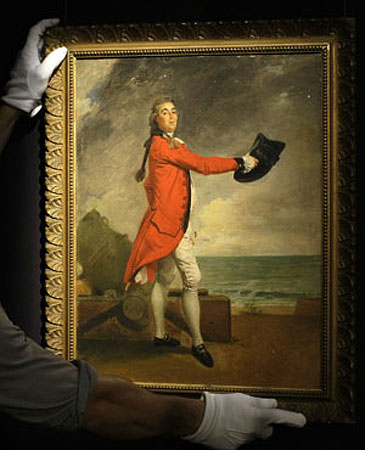
Artworks from the collection of the late fashion designer, Gianni Versace, went on sale at auction in March 2009. However, prior to the auction, one of the main attractions, a portrait of Major George Maule by 18th century German neoclassical artist Johann Zoffany was withdrawn.

An English family, who were direct descendants of the painting's subject, had recognised the piece as an old family heirloom when the auction was advertised, and contacted the ALR to seek to recover the painting.

Because the ALR was only established in 1991, it may have been thought that there was little the ALR could do to assist. Indeed, Versace was said to have been unaware that the painting had been stolen when he had purchased it. Fortunately, Vesace's estate, was willing to work out an arrangement to return the painting to its original owners, and it was ALR who helped to negotiate the case between the two parties. Thus, last week the painting had been reunited with family.


Source: The Telegraph 22 November 2010